Blog

  • Pet peeves and peeved pets

    Dog owners who allow their dogs off leash or who have no control over their leashed dog are a pet peeve of mine. Of course, pun intended. Last week, I was on a walk in my neighborhood by myself. Some dog walkers an awareness that they are in a public space and not everyone enjoys dogs. These people will take their dogs to an opposite sidewalk or walk into the street when they see me. The woman I encountered last week was not one of these people. She was not walking her dog so much as her small white dog was walking her right down the middle of the sidewalk. Still, for some reason, I thought that maybe this person would move herself and her dog to the side as I approached. But of course she didn’t. She just let her dog do what her dog wanted to do and started to insist to me “He’s friendly! He won’t hurt to you!” Clearly, what she failed to see wasn’t that I was afraid the dog would hurt me but that the dog was right in the path of where I was attempting to walk. Instead of having an encounter with her dog, I walked on to next to the sidewalk over the tree root terrain. She seemed genuinely disappointed that I didn’t what? Stop to pet her dog? Just keep barreling up the sidewalk? What I did do was ignore the woman and the dog. Some people don’t like to be ignored or so I understand.

    In any case, like, I said, for the most part most owners seem to exhibit more awareness than this woman does but I was still wary when I saw a dog off leash on my walk this morning. His owner was a few paces behind him. They both looked familiar but I’m pretty sure that on previous encounters, the dog was on a leash which was now casually tossed over the man’s shoulder.

    As I did before, I just kept walking. If a dog is off leash and doesn’t approach me, I don’t really have a problem with it. I am, after all, a dog owner myself. But I will quietly judge the dog walker and I definitely won’t be friendly.

    Here’s the thing about this dog that I encountered this morning: he’s a bull dog. Bull dogs are a strange mix of intimidating and comic. They look broad and strong like a boxer (the athlete, not the breed) but also like Winston Churchill. So when this dog came walking towards me, all jowls and jaunty stoutness, and then turned his head to give me a quick sniff, I honestly couldn’t contain my laughter. Bulldogs are just so ridiculous.

    I glanced up at the owner and it was clear he’d been clocking this interaction and my reaction. Clearly, he knew that his dog is ridiculous. He had a big smile on his face which, in turn, broadened my smile even more so that we were two people, vaguely familiar to one another, having a moment.
  • The imperative is to create.

    Whispered alarms in the village sound
    Boredom threatens the castle walls.

    Would that I had time to explain
    Suffice to say Prince and Princess are within

    ... we are without
    in our toil protected from idle attack

    alas, not so from royal's search
    for relief
    from royal ennui.


    I’m trying to challenge myself to write (and, on occasion post) more of my own poetry. I read recently about a writer (sadly I can’t remember who it was exactly) who wrote a poem a day. And part of this process was granting herself permission for it to be a bad one. I’m posting this one without judgement — good or bad. I live in a time when and a place where the imperative is to write, to express, and to create. There is no room for self censorship, judgment, and editing in that. I must press on.

  • No more waiting for permission…

    Approximately 25 years ago, I moved to Thailand, my dad’s country of origin to teach English in his hometown at his old junior high school. After about a year of doing that, I taught students at Karenni Refugee Camp #3 on the border of Thailand and Burma (or actually, the region of SE Asia that Burma was attempting to occupy, thereby creating the need for refugee camps). I returned to the US after a total of three years in Thailand and started an MFA program in creative nonfiction writing.

    My thesis was about the Karenni, some of their history and some of their stories, and centered around my time as a teacher in the refugee camp. My hope was that my thesis would lead to a published book or at least some essays and articles. I did end up writing and publishing an article for a local alt-weekly and one piece in a SE Asian studies journal after I finished my MFA. (Both were about the Karenni people.) All these twenty years later, I’m still performing a post-mortem on my writing “career”, more specifically, what happened to my thesis and pursuing this topic?

    Here’s a bottom line that I’ve reached: these (largely untold)stories are important. And also this: I’m tired of waiting around to get “permission” to tell this stories. I’m tired of writing and rewriting and revising and guessing at what the gatekeepers (yes, in publishing) want to see in order to publish these stories. And I’m also tired of holding myself back on sharing these stories and truths.

    I’ve been reading Faith Adiele‘s Meeting Faith and this weekend I was lucky enough to be able to take a workshop with her. Her first book was about her time as a Buddhist nun in Northern Thailand, not too far from where I lived in the refugee camp. I’ve learned a lot from her book and her workshop about storytelling. As a result, I’ve been thinking a bit about telling stories about Thailand and also about living in places as an “outsider” and especially as a person in a position of privilege (as I was in Karenni Refugee Camp 3). In addition, Faith taught my fellow writers and me about how to unearth some of these stories from our past. As these things go, right away, I was dreaming about people in the refugee camp, recalling events that I had long ago forgotten.

    Here is one of them.

    I worked from time to time with a young Karenni woman (I’m going to call her Marie here) who was often charged with interacting with English-speaking foreigners. Her English was excellent and she’d grown up in places that were frequently visited by tourists (yes, there were parts of the camp that were open to outsiders because the women there were an “attraction” because of some of their cultural practices; but I’ll have to tell that story some other time). In any case, I ended up connecting her with a journalist from a big US news magazine program. The two of us took this journalist and her camera people around to visit a few different villages over the course of a few days. Marie served as interpreter and was also filling in a lot of the background and historical context. During the course of it, the journalist apparently noticed that Marie often wore make-up. If I recall correctly, she made promises to be in touch with Marie again. And some point, the journalist mentioned sending her a gift from the states. A few weeks later, I was chatting with Marie, getting caught up with her when she mentioned that the journalist had sent her make-up from the states. And it turns out it was used lipsticks, shades that the journalist no longer found fashionable.

    In my dream, I saw Marie and there was a table-full of used make-up that had been set out for people to use.

    Here’s the point at which I feel as though I need to make sense of this story. I need to extract some sort of lesson about how people behave towards one another and the ideas of “need” and “gifts”. But, well, I’m just going to trust that I can send this story out into the world and it will end up where it needs to be. And that it won’t require my further input, evaluation, and assessment. In other words, I’m not going to participate in gatekeeping these stories.

  • On receiving (yet another) rejection

    I think I’m up to nearly thirty “nos” on writing submissions over the past couple of years. And not a single “yes” from someone other than myself. I’m not going to sugar coat anything here: it’s rough to receive all those rejections. I’ve had more than one time when I’ve just felt like giving up. How have I not?

    1. I have a writing community now, to boost me up and keep me focused on what’s important when I receive another rejection. For a long time I was going at it without any real community support and that was when I pretty much gave up on submitting. I joined my community (The Sanctuary for BIPOC women writers) without any real intention of submitting again. I just wanted to write. Of course, having a writing community meant that I was regularly reminded of the importance of writing and creating. Paradoxically, it also reminded me that I’m first and foremost writing for myself. Which leads me to …
    2. The greatest and primary beneficiary of my writing is me. The vast majority of my words will never see the light of day — or at least I write them without the intention of them going beyond my own eyes. Yet these words are still valuable. And this practice still benefits me. By the time I get to submitting something, all of those words have already served their primary purpose of guiding me towards a revelation, a sense of self, a lesson, and/ or a healing. They’ve already done their work. What someone else thinks of them, whether they get “chosen” or not is irrelevant.
    3. I am a writer. I am a writer because I call myself a writer. In my case, I also happen to write every day. And this month I’ve been writing a minimum of words because I’ve been participating in a November challenge in my community. But to call myself a writer doesn’t even rely on that specific daily word count. It doesn’t even rely on myself writing every day. And it certainly doesn’t rely on someone else agreeing to publish my writing. A few months ago, I was on the metro and a man came up to me. He asked me if I was an artist. I said no. I turned out he was an artist and thought I looked like one too. We got to talking and he asked me what I do. My canned response in these moments is usually “stay at home mom” (which is also true) but this time “I’m a writer” popped out of my mouth. I genuinely surprised myself with that one. But the bigger surprise was that I didn’t equivocate and I genuinely believed it when I said it. I’m a writer.
    4. I write every day. And if nothing else, a rejection is a reminder to me that I’ve not only been writing every day, but in some cases I’ve sent my writing out into the world. That takes courage. My writing reminds me that I’m a courageous person and, yes, even the rejections remind me of that too. That daily writing is so engrained into my habit that I hardly notice these little rejection blips. Compared to the ocean of words that I’ve written over my lifetime, the few thousand that comprised that particular submission are a mere drop.
    5. I do a bunch of other stuff too and I’m also a bunch of other people. Yes. I’m also a mother (and a pretty good one made better by my writing; just this morning I had a talk with my daughter about a poem I’m working on). I also go on walks and have long, serious talks with trees and plants on my walks. I knit. I play guitar. I make really good chai. I read. A lot. For enjoyment. When I received my latest rejection, I was just about to do my daily yoga practice. For a brief moment, I considered putting it off to write or take a closer look at the piece of writing that had been rejected. I considered quickly figuring out some other places to submit it (getting back on the horse is also a beneficial practice) but I went and did my yoga practice instead. I’m grateful that I have it there to keep things in perspective.

  • I’m writing this instead…

    … of playing that game that was advertised to me on my language learning app. Those ads are a small price to pay for a free service. The one I got sucked into most recently is the one with the balls of yarn and the dragon going after the kitten. Did the algorithm know that I knit and what my eastern zodiac sign is? Sure I also have a cat allergy but that doesn’t make me a monster. I’m still going to try to save the kitten, right? I’m frightened by how much they know about me. It’s not really those little details about my hobbies and autoimmune issues that I’m worried about. It’s that they seem to know how my mind works. Like, how difficult a task has to be to get me and keep me engaged without it being so challenging that I give up altogether. It was so easy to just keep clicking “retry” — so much easier than putting down the phone. And the music? It just built the tension, made me feel like I was on an adventure that I needed to complete, made me feel like matching these colors was somehow important.

    I got sucked into it for far too long last night. My problem — or one of them at least — is that I didn’t prepare myself by having something else to do instead of playing the game when it was advertised to me. Next time, I’ll have a book on hand that I can just pick up and read while I wait for the ad to time out or whatever it does.

    I used to play Tetris as a kid and I remember that feeling of the little shapes falling in front of my closed eyes as I was trying to fall asleep. Last night, it was those balls of yarn and the fiery dragon.

    And somewhere in the back of my head, I think, “Well, games and playing are good for me and my brain. Puzzles keep my brain engaged and active.” But do they, really? Am I actually having fun when I’m matching these colors? Or is it just that the games are tapping into some primal part of my brain that developed when searching for patterns in the environment was tied into basic survival.

    The other day, on my walk, I went to retrieve pinecones from a nearby tree. I was aware that this was the season when this specific tree would drop its pinecones that are the perfect size for the firestarters that we like to use and make. Searching around the base of the tree, it’s that same sort of primal lizard brain that the game activates. It’s the foraging brain looking for a specific shape and color against the grass. But outside in the open as my pocket filled up, it was easier to turn that off and walk away. Easier, anyway, than clicking “retry” on the yarn-dragon-kitten game.

    And this, too, this blogging … this writing and sending my words out into some unknown world … this is one of the ways in which I’m trying to replace the easy “retry” clicks. I leave my blog page open. I joined a challenge this month in my writing community to write a certain number of words each day. In this community I’m getting cheered on and supported in my writing endeavors. I try to remember every day that what I have to write and say is important. And in these ways, I try to make writing and blogging … if not easier than clicking “retry”, then certainly more rewarding. After all, the kitten is just pixels. I’m a real person.

  • Updates from beside the wood stove

    There are worse things, I suppose, than having so many things to do that fill me up and energize me. These past few days, it’s been cold enough that I’ve been making a fire in the wood stove. This has meant that a portion of each day has been spent alternating between reading and listening to a book while knitting next to the fire. It’s exceedingly cozy.

    I’ve been listening to The Very Secret Society of Irregular Witches by Sangu Mandanna which I think was written specifically to be listened to while knitting next to a wood stove. All of this feels very indulgent. But also very necessary. I received (yet another) medical bill in the mail today and I realized that the hours I spent being cozy and calm was shoring me up to deal with that particular challenge and other challenges yet to come. In spite of all of my health challenges, the professionals often comment on how my blood pressure is ideal. And I think that taking care of myself in these kinds of ways might have something to do with that.

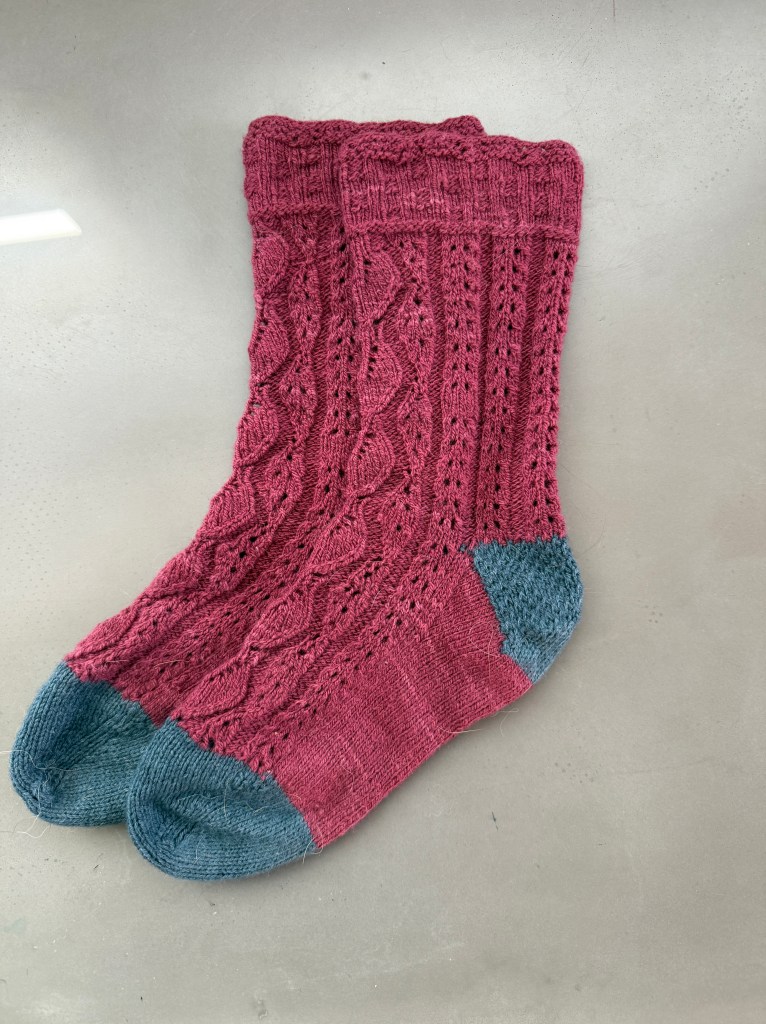
    These are not the socks I’ve actually been knitting these past few days; this is a pair that I finished before it was fire season. My daughter selected the colors and pattern from my stash.

    I’m grateful for all of the work that my past self put into making sure that I could weather these challenges. Many years ago, I learned to knit. And in the past few years, I’ve accumulated enough skeins of yarn, patterns, and skills that I can pick up a project pretty quickly. It gives me something for my brain and hands to do. Idle hands being what they are… And, of course, there’s always the satisfaction of finishing an item and then giving it to someone, sending it off into the world where it will do its thing. With each item I make, it’s a practice in letting go and in trusting that it will end up doing what it needs to do, being where it needs to be without any sort of effort from me. Once that final strand is woven in (ok, and I block it), it’s out of my hands. I’m done. It’s an exercise in letting go of control. Of course this translate into other areas of my life: parenting specifically. But also even with writing. I put the words on the page and hit publish or otherwise send it off. What happens beyond that is up to the universe. I have to be ok with that or else I’d never do any of it. But I am. And so I do.

  • How Will They Know I Love Them?

    This is the story of how I struggle with saying no to my kids. And also the story of how I struggle to say yes to my kids. And also of how I struggle to say yes to myself. And so therefore perhaps it’s about how I struggle to say no to myself. I guess maybe I could therefore say that it’s about how I struggle with decisions. And maybe that means that I struggle — and usually fail — to recognize the abundance that has been gifted to me.

    It begins with a corn dog. It was the weekend. My daughter wanted one. What she really wanted was to go to one of her favorite restaurants to get a corn dog and a bubble tea. But she never told me this directly, she just kind of hinted around it. I would like to say that I have a strong “mother’s intuition” and that I pay attention so closely to my kids needs and wants that they never have to express them: I just know. But that’s not what’s going on here. At first, I thought that my kids don’t always ask for what they want directly because they don’t like to hear “no.” But I’m starting to realize that my kids sense that I struggle to say “no” to them. They don’t like to see that struggle and so they edit themselves before it even gets to the whole asking directly for their wants and needs. They kind of “test the waters” with hints and indirect comments. It’s not to save themselves from hearing a no. It’s to save them from having to watch me flounder and go back and forth and try to make a decision.

    So I knew that she wanted to go get a corn dog. (Honestly, she’d probably want to get a corn dog every chance she got so this wasn’t any sort of revelation.) And I went back and forth inside my own head on whether or not I wanted to take her to get one. It would take a while, a chunk from their day off from school. But it’s always nice to have these types of trips with her or, really, any of my kids. Corn dogs aren’t the healthiest option, on the one hand. On the other, part of me really does believe in a sort of “do what you enjoy” attitude. We didn’t really have a set lunch at home so why not go out and get something? But, then again, I also had things I wanted to do and enjoy at home. And she had never really asked directly to go. I’d like to think that if there’s one lesson that I’m trying to instill in my kids, it’s to ask directly for what they want from me. And here I was trying to come up with an answer to a request that she hadn’t even made yet.

    And here’s the real crux of the struggle, “If I don’t anticipate and meet their every hearts desire, how will they know that I love them?”

    So I was in this internal state of debate, letting all of these back and forths slowly eat up my morning. Finally, she asked me, directly, “Mom, do you like the corn dog restaurant?”

    It was the first direct question she’d asked all morning about lunch and it wasn’t at all the question I’d been planning for.

    “Well,” I explained to her. “I like corndogs, but they aren’t the healthiest option for me and I’m trying to focus on eating in a healthier way these days.”

    And that was it. She didn’t mention the corndog restaurant again the rest of the day to me. She asked me to help her with cutting celery and onion so she could make herself a tuna melt, which she seemed perfectly satisfied with. And we had a perfectly nice time at home. We’d played volleyball together in the morning. Later, she came to me and asked if I’d play with her again. I was in the middle of writing a poem so I told her, “no.” She tried to convince me a little more but I stuck to my commitment to my writing.

    Of course, it wasn’t easy to say “no” to her. She wanted to do something perfectly wholesome with me, her mother outside on a lovely day. And, of course, in the back of my head, there’s always the thought, “one day my kids will move out and be on their own and I won’t have a chance to play volleyball on a beautiful fall day with them.”

    Later, I found out that she took that time to clean her room.

    And I realized that my always giving more of my time, my attention, my energy every time they ask for it isn’t helping them. I realized how much they are really, truly watching everything I do and soaking it all up. When I say, “no” to them, often it forces them to figure out a way to say, “yes” to themselves, to improving their environment, to taking care of themselves and their health. I had been modeling self-love all along and didn’t even realize it. But she had seen it. And now she could practice it for herself.

    “If I don’t anticipate and fulfill their every want and need, how will they know I love them?” They will know I love them because they see how I love myself. They know I love them because I do.

  • The Fall and rise of yin. (And Happy Halloween.)

    Autumn brings the rise of yin energy, which I’m happily receiving (which, is, appropriate given that yin is in part about receiving). I live in a place where capitalism, patriarchy, etc… creates an imbalance of yang energy — the more fiery, get stuff done, always be on the go, make, produce or die kind of energy is always around. It’s a little too easy to tap into it. To the point that even when I’m even wondering: “is it possible to embrace yin energy TOO MUCH?” This is about sitting back and receiving, after all.

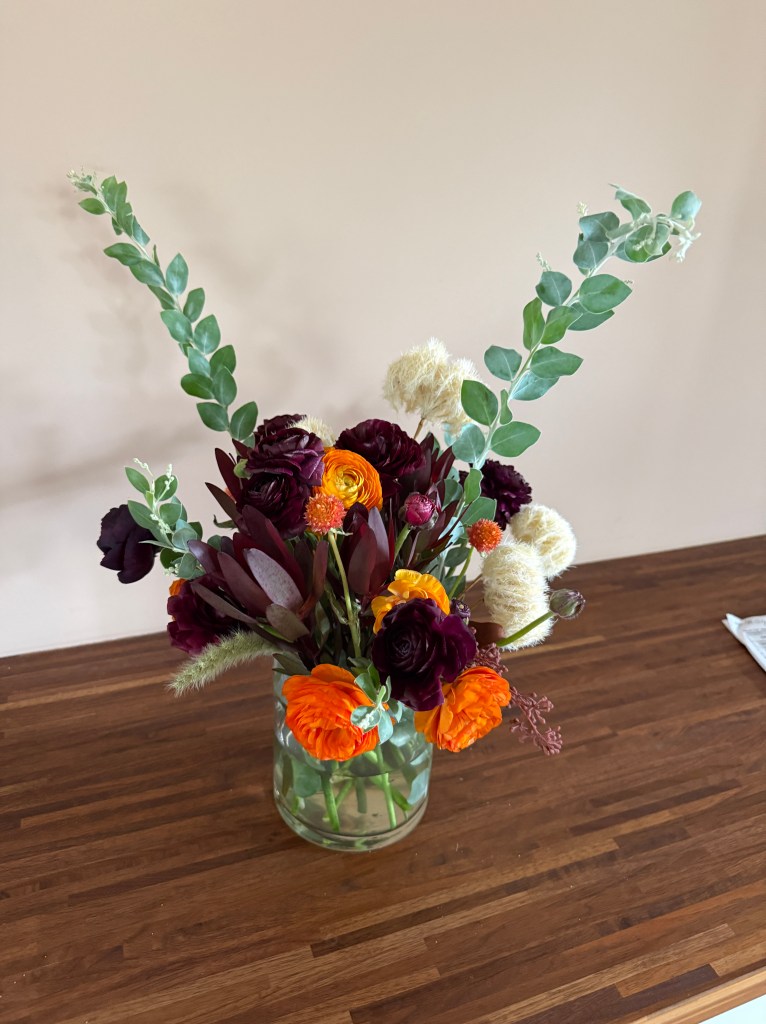
    The other day, I went to Trader Joe’s and picked up some flowers. At home, my daughter and I arranged them into a vase. It’s beautiful. I’m really proud of it. And every time I look at it, I think, “wow, that’s really beautiful” and I appreciate myself for having picked out and purchased the flowers and for having created a moment with my daughter from which emerged something beautiful.

    Isn’t it beautiful? Of course it is.

    I give it a 10/10 no notes. Would recommend. It was a completely perfect series of events and lovely outcome which I continue to enjoy.

    And one of the best parts of the whole thing was that I just received all of that. I didn’t doubt or question. I didn’t hedge. I didn’t think, “oh, I should have done this differently” or “this isn’t quite as good as that other bouquet, experiences, moments, thing that I saw on social media, etc…” I’ve experienced each step in the process of creating and I’ve enjoyed it and moved on to each next moment. Now, I look at this bouquet and think, “that’s really lovely, it really brings me joy and I’m so glad I did that.”

    It’s taken me work, a lot of work, to get to this point where I allow myself to just enjoy these experiences and connections and beauty. But the more I do it, the more I think, “I made something beautiful” or “I’m really proud of what I did” and the more I share these moments (for example here on my blog), the more they build and accumulate and snow ball. They drown out the hesitations and doubts.

    A thing that my daughter taught me recently. The reds and oranges and yellows and browns of autumnal leaves are always there. But from spring through summer, these colors are covered over by green. In the fall, the trees pull back their chlorophyll, which is no longer useful to them and what is revealed are those shockingly beautiful colors that have been there all along. I love a verdant summer. But I cannot sustain that: the constant going and growing and moving and producing. Even the trees can’t sustain it. And what is there underneath, once all that green has run its course and is pulled back, is just as beautiful AND has been there all along. Now is the chance I get to admire all that has been with me underneath the green all the time. I’ve always had it in me to choose a variety of flowers and arrange them into something striking. Now, in the yin energy of fall, is my time to appreciate that and all my other gifts. I hope you can too.

  • To Bike or Not to Bike?

    It’s a sunny, 60ish day here just outside of our Nation’s Capitol: a perfect day for a short, easy bike ride up to my local library. I’ve recently fallen in love with my library as a space to write and read surrounded by books and people who, for the most part, seem to also be readers and writers. Mostly, I’ve been driving up there but a few times recently, I’ve enjoyed the ride. So after checking the weather forecast for this week, I’d earmarked today as a day to ride. I loaded up my lunch, my notebooks, and books into my panniers and set off, helmeted and ready for the two miles or so.

    I live right next to a very busy highway that varies from 6 to 8 lanes. The library is on the other side of this road so I have to cross it at some point to get there. Lately, I’ve been using an unmarked crosswalk without a signal. Early enough in the day, there’s been a long enough break in the traffic that it’s a very lowrisk crossing.

    I’d pulled over to rest on a curb and to wait for an opening in the traffic when I saw the markings on the asphalt on the roadway in front of me. Blue and orange spray painted circles dotted the intersection. They might as well have been hieroglyphics. I did not understand them. But I did know why they were there.

    On Sunday evening, driving back from a family visit, there was an unusual amount of traffic along our residential streets. I conjectured that something was going on one of the arterial roads that was pushing traffic onto these side streets. Sure enough, after I pulled into our driveway, I went out to the highway to see the blue and red lights of emergency vehicles circling around. Eventually, two neighbors passing by informed me that a driver had hit a pedestrian and the roads were closed.

    So here I was staring at the orange and blue circles that meant something specific to someone about the events of Sunday evening. All they meant to me as I sat on my bike waiting for an opening in the traffic was that a person had been hit along this road. Again.

    The police would report that it was a 13 year old girl attempting to cross the highway who was in critical condition at an area hospital. This information was repeated by local news outlets. However, I heard from a reliable source that a teenage boy (a student at the nearby high school) had been hit by a car on Sunday evening along the same highway. So either the victim was misidentified or two people were hit by drivers along the same highway the same night. As unlikely as it might be, the latter isn’t entirely out of the realm of possibility. In the last four months, drivers have hit three other people in a slightly more than one square mile area. All three were killed.

    On the side of this highway, waiting for a break in the traffic, I wonder whether the drivers are thinking about the young person who was struck at this intersection like I am. I know that crossing this road is the most dangerous part of my ride to the library. I consider walking my bike up to a marked crosswalk with a signal, but both of those are a distance to walk especially pushing a bike on the narrow sidewalks. And then I have to consider my ride back home.

    So I climb off my bike and turn it around. As I’m riding back to my house, I consider whether or not I should just drive up to the library. Even if it is safer, I don’t really want to be another driver on the road. I’m lucky. I have a nice, safe house with most of what I need (other than, of course, the community of people at the library). I don’t have to go anywhere and even though I really could use the exercise and fresh air and human interaction, I have to weigh those benefits against the stress of trying to walk or bike safely within this infrastructure built for cars.

    Here I am, back at my house, having chosen the “not to bike” option. And I’d be lying if I said I wasn’t sad and disappointed. How I’d rather be at sitting at the library seeing those increasingly familiar faces, writing about something more joyful than drivers killing and maiming people, my neighbors. But this is what’s on my heart. And it’s honest. So at least there’s that.

  • Critical Response Process (aka “Gentle Workshop”)

    I learned this alternative process for a writing workshop from the poet, teacher, and writing mentor Ariana Brown. These are the five steps:

    1. The readers (viewers/ audience/ workshop mates) give statements of meaning.
    2. The writer (artist/ speaker/ performer, etc..) asks questions and can state their goals.
    3. The readers pose neutral (non-judgmental) questions and the artist can respond to those questions.
    4. The readers ask for consent to share opinion statements, ideas, suggestions. If the writer consents, the reader shares their thought.
    5. The writer can answer the question: “What are your next steps?”

    I’m going to delve a bit more deeply into how each of these five steps work and to give more information about my experiences with workshopping my writing both with a more “traditional” style of feedback and using Critical Response Process.

    I have an MFA in writing and a BS in English Education. I’ve experienced writing workshop since I was in elementary school and studied how to give feedback as a teacher and I’ve received feedback as a student in various workshops. For the most part the way that I’ve experienced feedback has been what I view as “traditional.” The workshop is comprised of a group of writers and one teacher/ leader/ expert writer. Each week (or however often they meet), writers turn in their writing so that the whole group has time to read ahead of meeting. In the meeting, each of the pieces that was shared ahead of time is “workshopped”.

    Up until this point, the Critical Response Process and the traditional workshop are the same. Here’s where they diverge.

    In the traditional workshop (as I have experienced it), each reader comments on the piece in turn. Other than clarifying questions, the writer is largely silent. In general, each reader shares their thoughts in a “compliment sandwich”: a positive comment, a suggestion, and then concluding with another positive comment. I’ve never had a workshop leader say that this is how it must be done, but it seems that everyone kind of just defaults to this way of commenting. Once everyone in the workshop has shared their thoughts, the workshop leader then usually wraps up the discussion with some sort of unifying overarching comments about the piece. At some point, the writer will have a one-on-one meeting about their writing with the teacher. (Of course, some writing workshops are peer-to-peer in which case there’s no private meeting and no one wraps up the discussion in a sort of “expert” way.)

    In retrospect, I can see how this format is not centered on the artist and their needs. The comments, at times, were rather arbitrary and based more on what the workshop mates wanted to talk about than what the artist needed.

    My experience with the Critical Response Process was very different. Here are some examples of how each step might be worded.

    1. Statements of meaning might include particular phrases or sentences, lines or images that resonated for the reader. It might also include what the reader took away from the piece of writing. Not everyone must comment during this part of the process. I found this to be a very nurturing and supportive place to start the whole process.
    2. The writer or artist might ask how the readers responded to specific images, language, moments, the form, etc… of the piece of work. They might ask for help sorting through parts they found particularly tricky or if the reader needed more explanation. I found this very helpful as a writer because it allowed me to ask for help where I needed it rather than just waiting to see if someone else brought it up. In addition, as a reader, it was helpful to learn where the writer specifically wanted help.
    3. Some examples of neutral questions, “How did you choose this topic?” “How did you decide what form to use?” “Where did you get your inspiration for this line?” I experienced this part of the whole process as driven by genuine curiosity. As a writer, it actually felt good that the readers were so curious about my process and my decisions. And as a reader, this often lead to rich discussions about process and a way to learn about other artists and how they work.
    4. At first, I was confused about asking for consent, but once I saw it modeled for me, it made sense. “I have an opinion about the title of this piece. Would you like to hear it?” Or “A piece of writing that reminds me of your poem. Can I recommend something that you might want to read?” Or “I have an idea about where you might submit this work. Would you like to know about that?” It was all very gentle and, for the most part, it just gave the writer more ideas and just furthered the discussion of their work and often contextualized it in a very empowering way. And once I saw it in action, I understood the consent piece. As a writer, I understood how maybe sometimes I just wasn’t in a place where I wanted to hear an opinion about something about my work and it was empowering to know that I could disregard what was said. Also, as a reader, it slowed down my response and reminded me that the person on the other side of the Critical Response is a human being.
    5. It was very nice to end the discussion back with the artist rather than the “expert” or “leader”. To me that was an empowering part of the experience and it served as a reminder that, actually, when it comes to my writing, I’m the expert.

    I found this process of giving and receiving feedback to be much more focused on the need’s of the artist, gentler, and more supportive than the more “traditional” workshops that I had experiences. I’ve also found that I can use a similar process to edit and revise and look at my own work. I don’t always need a whole group. And this has made me much gentler with my own writing.