Blog

  • New Substack Launched!

    “Our Hermitage” is the new Substack newsletter/ publication that I’m thrilled that my friend, Claudia Suarez, and I just launched together. Here’s a little snipped from our About page:

    “We’re so happy you found Our Hermitage! Welcome! Grab a cup of tea and a journal if those are your things… whatever makes you comfortable. We hope you’ll settle in for a cozy rest in this space where you’ll find our stories, reflections, and wisdom that the two of us (more on who we are below and in our Origin Storypost) have gathered on our fifty turns around the sun. We, two middle-aged life-long friends and self-proclaimed hermits, meet with each other once a week (at least). The conversations are magical: full of story and wisdom, spirit and connection. The fruits of our friendship are too delicious and juicy to keep to ourselves. Our Hermitage is our space to offer a little of this joy and magic.

    During these meetings we also choose a monthly theme (eg, reconnection, discipline and spontaneity, and intuition) that we explore with each other, curious hearts, and open minds. Subscribers (hi!) can expect to receive a monthly newsletter covering the previous and upcoming themes in their inbox. We look forward to sharing our writing and reflections around the theme in Substack posts on a regular basis so we hope you’ll visit often. Our hope is that this space is a cozy resting place for those looking for ease, inspiration, and even a dose of magic.”

    Claudia and I have been friends since we sat next together on the first day of first grade. (We have photographic evidence.) Was it assigned seating? Was it fate? I’m going with both. Our paths have crossed in and out of each other’s lives since we each went off to different high schools. The “Our Hermitage” is where we are fully walking into our roles as “village elders.” We have a lot of wisdom, words, and stories to share. And I hope you’ll consider joining us there. I also have my own “Rhena Writes” Substack but the material can mostly also be found here. The “Our Hermitage” writing and other art cannot be found anywhere other than Substack (for the time being).

    I hope you’ll consider joining us there: https://substack.com/@ourhermitage?r=8axlf5&utm_campaign=profile&utm_medium=profile-page

  • Creatures Winged and Unhinged

    My skin crawled before I even knew what I was looking at. Because it seemed as though the ground was moving. Not quaking or shifting, but writhing. Is it maggots? My usual peaceful morning walk turned abruptly into a horror movie as I tried to figure out what sort of foulness from which a mass of fly larvae could burst forth in such a way on the path right in front of me. I should turn away. 

    But I didn’t. 

    Thanks for reading! Subscribe for free to receive new posts and support my work.

    And as I looked more closely, I could see that I was wrong. And of course I was wrong because Mother Nature would not have done that to me. This darker section of this asphalt wasn’t writhing, it was shimmering. Winged ants wiggled their way along the trail. How had they all come to be together in this particular spot of the trail? And how had the birds not already taken them all? Now that I could see that it wasn’t maggots emerging from some rotten flesh, I stepped carefully to the side so as to avoid stomping them and carried on my daily loop, wondering if they’d still be there when I next passed by them. Ten or so minutes later, they were mostly gone. 

    A robin stood innocently by. 

    In the interval, I clearly had not learned or seen what I was meant to learn and see from these creatures for as I walked further along the path, I saw another patch of winged ants. Like the first group, they were clustered around a crack in the asphalt that ran the width of the path. Had they recently emerged from the ground beneath? I considered that they were shaking their wings dry or else attempting (having never used those flight muscles before) to lift off from the ground. Still further on, another batch was doing the same shimmy shimmy shake shake with its brethren creating a sort of disco disc as sunlight glinted off their gossamer wings. 

    Three summers ago, a few times each week in July, a flock of starlings would take flight outside my kitchen window and murmurate through the sky over our roof and our neighbors’ houses. (Yes, in the summer, as unlikely as that might seem.) And it was beautiful and made me feel chosen. 

    But as I stand over these flocks of ants, I think of the magic of those birds taking flight. But I do not want to experience these ants in the same way. I can almost feel them flying up my nose and into my ears and I do not want to be chosen in this way and I take one step back but no more, thankfully, because then I would have missed the way they take flight not en masse but one by one, on their own, reminding me of (sorry for the spoiler) Charlotte’s babies at the end of the book about her web and the talking pig Wilbur. And I manage to find within myself the ability to appreciate a certain grace in their flight that I cannot see in their wingless cousins who somehow find their way onto my kitchen counters each spring. 

  • How One Tree Made Itself Known

    Yesterday, my friend Claudia reminded me of the importance of going barefoot. She had a good point. Foot health is important. In Chinese medicine, the whole body including every organ is connected to our feet. When I lived in Thailand, foot massages were a regular part of self care and health, but it’s also a tropical country which meant that I feet were, well, footloose and fancy free. Back here in the US, my dogs spend a good portion of the year wrapped up and cozy. I love winter in my midatlantic region of the States precisely because enjoy a good pair of warm wool socks. I love making warm wool socks. I love buying warm wool socks. And I love wearing warm wool socks.

    But Spring is upon us now and I realized how right Claudia was. My feet had been boxed in. We saw a good amount of snow and ice this year which meant that my feet saw the inside of boots a good amount this year.

    I’ve been getting this one plot of forest-park land in my neighborhood for a few years now with regular walks over the same stretch of ground over and over again. It changes every single morning.

    The other day, I was walking in one area that I’ve probably for too long considered the least remarkable part of my walk. The stream isn’t visible, there’s no real view, and it basically feels as thought it’s just someone’s backyard. But then something unexpected happened that made me take a second look. I was walking past a tree that had already lost its blossom. Which, yes, I’m going to admit that I probably didn’t think it was worth a second glance. I live in an area (the DMV) famous for its cherry blossoms. And I, too, sometimes get so caught up in the spring flowering tree frenzy that I undervalue the trees without showy flowers or the ones that have lost theirs. What can I say? I’m a blossomist.

    And then the other morning, as I was walking by, largely ignoring this post-blossom tree when it touched me. And when I say, “I touched me,” I mean that a branch from this tree that had not been anywhere near my face as I approached, brushed the side of my head as I walked by. I turned around and looked at the tree. And laughed. “Ok,” I thought. “You got my attention.” Said branch? When walked back, I had to reach my hand as far as my arm could reach and lift my heels off of the ground in order to touch its leaves. Nobody can tell me that tree wasn’t trying to initiate contact.

    I’m nearly fifty years old and I had a unilateral mastectomy last year for breast cancer. I know the feeling of being overlooked once my blossoms dropped. The good news is that that tree and I are now besties. And I’m looking at her section of the park in a whole new light.

    So on my morning walk today, I really paid attention to her and her surroundings. What must it be like to live in her part of this world? This required further investigation.

    I furtively glanced around to make sure that I didn’t offend anyone with unshod feet, took off my shoes and socks and carried them across the green carpet of (not grass but) lesser Celandine. (I had to look it up; I’m not able to recognize and name plant species like I once was able to as a kid but I’m working on it and perhaps I’ll even be writing more about plant identification.) In spite of it being called “lesser” (it’s always a competition with western plant naming systems, isn’t it?) this Celandine was lovely, and cushiony, and just a little bit squeaky.

    But there was still just enough of a chill in the air and greenery, that my feet quickly got cold. Thankfully, my wool socks were still warm tucked into my shoes and after a quick dusting off of my soles, I quickly tucked them back in.

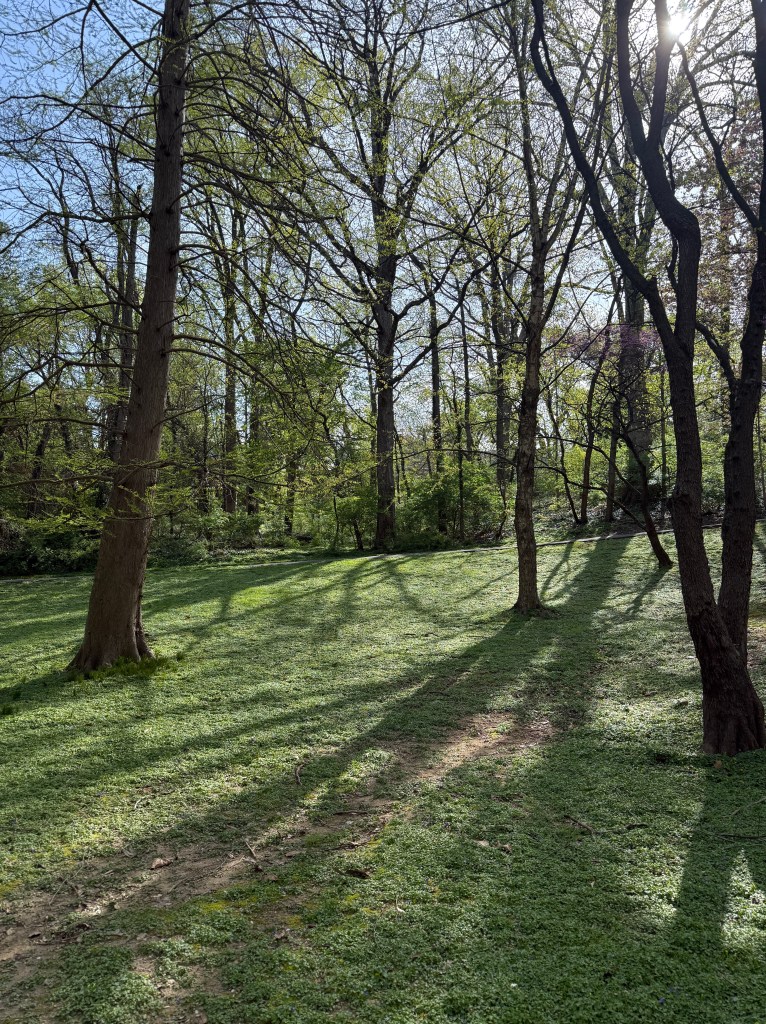
    I took a picture of the stretch of ground that I crossed. (My girl is just out of frame in respect for her privacy.)

    The chill, the green, the Earth itself: it’s all very enlivening. Oh, and, of course, my tree friend. My feet were happy to be freed — even for a few moments and just a few dozen steps across the Celandine (nothing lesser about it) and dirt.

    Live action shot of me after my shoeless, sockless morning jaunt.

    (Shout out to my Gen X people who appreciate this reference.)

  • Blog Repost: The Doctrine of Chai

    “Time catches up with kingdoms and crushes them, gets its teeth into doctrines and rends them; time reveals the foundation on which any kingdom rests, and eats at those foundations, and it destroys doctrines by proving them to be untrue.” –James Baldwin from The Fire Next Time

    Most of my mornings begin with making a cup of chai. Actually, it’s more like four cups: two for me and one for each of my two daughters. My son has yet to show any interest in having his own and my husband has never been a warm beverage drinker. (Yes, that includes coffee. Cast aspersions as you will. He’ll never know.)

    Here is where I explain the process of making chai. And perhaps a little bit of the history. But this isn’t really that type of essay. What type of essay is this? Let’s find out. 

    First, I pour about two cups of water into the pot and set it to boil. I pull out my round, lidded chai box packed tightly with smaller also round containers each holding a different component, which varies only based on what has been available at the Asian market (where spices are cheaper than at the “regular” grocery store). Cinnamon sticks, fennel seeds, rose petals, cardamom pods, star anise, candied ginger, whole cloves and, of course, black tea leaves. I’d like to say that I choose what to add based on some sort of higher sense of what my kids and I need that day. Extra rose petals for love. Cinnamon for protection and boundaries. Star anise for good luck (especially if I find a rare nine-pointed one). But the truth is that I mostly do it by rote: scooping small amounts of whatever is available. This is with the exception of fresh ginger, which I will pull from the fridge, slice thin, and toss in the pot if any of us has a cough or cold. This makes me feel like an apothecary. Or a witch. 

    My daughters have helped me on occasion. One such time, my older daughter commented, “This is what I think potion-making is like.” The other daughter recalled when they were younger playing in the yard, they would mix up batches of something that seemed, in their imaginations, to be both nourishing and magical. Our morning chai feels a bit like that with the added benefit of being also drinkable. 

    While the tea and spices steep on medium heat, I can step away from the stove to feed the dog or take my medicine, cut up an orange or make the bed. The next step requires my full concentration. I pour the two cups of oatmilk into the pot and watch the white whirl into the dark brown (“clouds in my cha-ai, clouds in my cha-ai.”). The liquid starts to bubble. It reminds me of the edge of the ocean where the surf breaks and kicks up sand. It’s a similar sandy color and, at least for this moment, similarly unappetizing. But then just when I start to think, “am I really going to drink this?” the roiling becomes suddenly light and almost airy. Just the right amount of foam. This is point when I have to watch carefully as the liquid climbs the sides of the pot. I keep one hand on the handle of the burner and the other holds my measuring cup which I use to scoop and pour the chai, thus aerating it further. I want the drink to bubble up as high and for as long as possible without it spilling over. I have no idea whether this is the goal or whether this is good chai making technique. I’ve found I just kind of enjoy the challenge. 

    On more than one occasion, I have let the pot boil over, not only wasting the precious tea, but creating a sticky mess that needs to be cleaned. Once or twice, this happened when I let myself get called away from the stove during this crucial stage. Shockingly, it’s also happened when I’ve been right in front of the stove, hand on the burner knob, eyes on the pot. How is it possible that my body can be in the right position, my eyes laser focused on the pot, and yet still it boils over? There are times when allowing my mind to wander, perhaps to even dissociate from my body was perhaps something of a gift. But dissociating is not the doctrine of chai. 

    One day, after I’ve been practicing this for years, will I be able to space out? Will I be able to let my mind wander and still be able to keep track of the tea and the pot and the foam and the heat? Do I want that day and moment to arrive? I do not. Dissociating is no longer a gift. Embodiment is. 

    Ritual is routine made holy and some call the product of this particular chai ritual “liquid gold.”

    This winter, I watched by daughter play a lot of basketball. Observe a player take to the free throw line and you will see ritual. It’s not just that the shooter has her own pattern of familiar actions (dribble three times, line up knuckles on the ball, place toes a set distance from the line, breathe), but the crowd also participates. At one of my daughter’s games, every time a player on her team found herself at the line, the cheerleaders would all silently extend their hands and twinkle their fingers in the direction of the shooter. I could almost see the fairy dust flit through the air. When an opposing player was on their line, the cheerleaders were less quiet. “Rebound!” they’d chant while stomping their feet on the stands. These rituals were all familiar to me from my own days in high school, save one thing. The noise the fans used to make when the opposing team was on the line used to be aggressive —  hissing and booing meant to intimidate the shooter. But the “rebound” chant of today’s young people encourages their own team rather than trying to disrupt the opponent. I love this generation. Each time I observe them practicing the power of approaching the world from a place of support rather than tearing down, this Gen Xer is a little more healed. 

     Are you with me here? Do you see the magic in the mundane? Do you see how there is no doctrine of chai? Do you see how the ordinary is not a kingdom? How ritual creates a bubble around us pulling us away from time’s awful teeth?

    At least some of the magic is in the returning, coming back to this pot, this stove at this time each morning. Yes, even coming back to the foul line. Day after day like a miner returning to the depths of the earth, digging a tiny bit each day in search of that seam of gold. Here. This writing is a bit like that too. I’ve returned to this piece day after day first in my little notebook filling up with my sprawling handwriting. Twenty minutes at a time. I set the timer and drew the habit tracker to keep me honest in the moments when my faith in the ritual of return faltered. And here we are because reading is the other side of that. A partnership. 

    Showing up to the stove is not dissimilar from showing up to the pen and paper or keyboard and screen. And it’s not dissimilar from sticking it through to the next paragraph or page. These are acts of devotion. And devotion always transcends doctrine. These commitments to these rituals. We are not kingdoms. Nor are we the foundation. Whenever we choose to return, to focus ourselves to a particular task, to a particular ritual, to a particular moment, we become an ally to time. And together we rend kingdoms. Here. A pause. A slurp of chai. The steam creeps up in front of my screen. I made this pot a few hours ago this morning between my morning stretches and morning writing. I reheated it just now so I could have the creamy comfort here as I venture back down into this particular mineshaft. Liquid gold to fuel my search for that seam of gold somewhere in these folds of my brain. Oh! Here it is. 
  • The story of this poem.

    I wrote this poem at the end of last year, 2025. It was inspired by a prompt in a literary journal that posts a piece of artwork each month and solicits ekphrastic poems inspired by the piece. The artwork that they posted one month last fall is titled grief seance: disjecta membra. I started brainstorming some words and scribbles about this artwork.

    At the time, I was reading The Collected Poetry of Nikki Giovanni and I came across several poems that felt connected to this piece of artwork. This led me down a path of discovering the poetic form called the “glosa”, which is originally a Spanish form which involves referencing four lines of another poet’s work. I started trying to figure out which four lines of Giovanni’s I might use to build out my ekphrastic poem.

    Around the same time, I came across the “cento”, which is a poem that pulls lines from other poet’s work. The original artwork was subtitled “disjecta membra”, which means, essentially, bits and pieces of art (pottery, literature, cultural artifacts, etc….) that have survived. Imagine the flotsam and jetsam of an archeological dig.

    This drew my attention to the poem “Ode on a Grecian Urn” by John Keats because it is not only ekphrastic, it is about an ancient piece of pottery. In grief seance, the woman at the center of the work appears to be in the process of being freed from a large piece of pottery or an urn. One of the things that I most admired about this painting was that it felt full of movement and the woman at the center seemed on the cusp of a great change. She appears to be about to take a step forward. When I read a bit more about John Keats, I learned that he was quite fixated on the idea of “immortality” and certainly Ode on a Grecian Urn seems to me an ode to these moments frozen in time. I wanted this poem to bring these different ideas into conversation.

    So I decided to use four lines from Keats’s poem for the “cabeza” (or head) of the glosa.

    I was still reading Nikki Giovanni’s work and kept coming across lines that felt like they belonged in this poem. That’s when I decided that this poem shouldn’t just be a conversation with John Keats but to bring a multiplicity of voices. So it would be a cento too. All of the poems I decided to references were written by women and the idea of a poem written with the “disjecta membra” of the feminine called to mind a patchwork quilt. The woman in the painted is nude and I thought that maybe she’d like a quilt, not to cover her body but to keep herself warm.

    Thus spurred a week or so of reading and noting and pulling lines from dozens of poems and stitching them back together. It was a lovely week.

    It was during this time that I learned from the poet Nadia Alexis that the journal I was going to submit to didn’t have a great track record of publishing writers from the global majority and those who have traditionally been marginalized in publishing. This was disappointing by not surprising. Still, I was so enjoying clipping and sewing that I carried on and completed the poem. I did still submit it to the journal. Needless to say, it wasn’t accepted. I had already learned and grown so much through this process of creation that I barely noticed the rejection.

  • (ekphrastic x glosa) ÷ cento = patchwork quilt poem


    Thou still unravish’d bride of quietness
    Thou foster-child of silence and slow time,
    Sylvan historian, who canst thus express
    A flowery tale more sweetly than our rhyme
    — John Keats “Ode on a Grecian Urn”

    I could build a container to carry this being the way I move
    in my mind, unencumbered by beauty’s cage.
    Stopping at a bronze shard
    she examines it/ the sea, the red cliff, my love
    getting lost in a firebrick landscape of his
    and said, fully of an awe full of sadness,
    She touched this, her skin was inside of this.
    she was forever fascinated by putting the pieces
    together I was a mask, made a mess
    Thou still unravish’d bride of quietness

    you thought this made you special. your silence was exquisite;
    a vessel of mortal emptiness broken into a hundred thousand little pieces
    You will know each fissure as it breaks open your life
    breaking through, breaking blue and we open our mouths to
    finally celebrate it. A celebration should leave a mess —
    truth is the dead who leave everything behind
    Some paintings make me cry./I Like Crying
    I will keep broken things:/ the big clay pot
    And soft captivity involves the mind.
    Thou foster-child of silence and slow time,

    Silence kneads your fear
    to know how utterly I have slipped its gilded
    hands go back where it came from. clean the room.
    Around her, what must be evidence of
    this was all sentimental crap, you
    sweeping the broken … / glass from beneath my feet with such/ Tenderness
    she was forever fascinated by putting the pieces
    together as in. I had no idea I would be here now
    Live coiled in shells of loneliness,
    Sylvan historian, who canst thus express.

    I am a continuance of blue sky
    This body is a song-/ bird in a kiln.
    my body is not just my body, but that I’m made of old stars and
    a broken pot bright as the blood/ red edge of the moon
    Read your grief like the daily newspaper: “Fragment of a Vessel,” it read
    You are Resplendent. You are Radiant. You are Sublime.
    Then on your skin a breath caresses
    The salt your eyes have shed
    when the time came to stand and climb
    A flowery tale more sweetly than our rhyme


    This cento is comprised of lines originally composed by the following poets: Claudia Rankine, Ada Limón, Adrienne Chung, Staceyann Chin, Natalie Diaz, Nadia Alexis, Ama Codjoe, Nikki Giovanni, Donika Kelly, Kai Cheng Thom, Samantha Gadbois, Lisbeth White, Destiny Hemphill, Mai Der Vang, Maw Shein Win, Alice Walker, Phillis Wheatley, Toni Morrison, Patrica Smith, Alexis Pauline Gumbs, Natasha Tretheway, Dr Jayé Wood, Ariana Brown, Maya Angelou, Joy Harjo, Athena Nassar, Audre Lorde, Lucille Clifton, Deborah A. Miranda, and Kimiko Hahn. Arranged by Rhena Tan and inspired by the artwork of Pleasure Faith.

  • Keeping the home fires burning

    The deal around this house is that if the temperatures go into the fifties or above, we don’t have a fire in the wood stove. Sadly, today is one such day. I’m still sitting next to the stove even though it’s little more than an empty metal box right now because it’s still a comfy spot, just not quite as cozy as it is when there’s a hot glow emanated from the box.

    The fire is one of the ways that I get myself through the winter, especially in these fewer and fewer minutes of sunlight each day. I know. In this day and age, what’s the problem? We have plenty of indoor electric lighting and, yes, I do turn on many lights during the dark evenings, but somehow the glow of the fire just heals me right up. It sparks something primal and constant in me. It serves as a reminder that my ancestors made it through winters with little more than such a fire.

    The fire is also deeply satisfying because it’s something that I have to build and tend to: splitting kindling, carrying in wood from the stacks outside, making the fire starters. I couldn’t explain how to take care of the fire to someone else, it’s just becoming the second nature that arrives only with much attention and experimentation. Knowing what piece of wood needs to go on next, whether the damper needs to be opened or the embers merely stirred up. Yes, the smoke alarm went off as recently as the last week when I wasn’t being attentive enough but even those moments are becoming fewer and further between. There’s even work for the kids: stacking wood, unloading it, checking the moisture levels. And it’s particularly satisfying when one of them curls up for a nap on the nearby couch, stands in front of the box to warm his hands, or just stares into the flames. Yes, much of the time, they’d still choose looking at a screen (they are human children, after all) but I know that at least having the option of resting their eyes on the fire through the winter months kindles something in their imaginations. I’m guess anyway. And I’m projecting. I know that glow of the fire does something that no screen can do.

    Last week, we heard a strange noise which inspired me to call the company that installed and maintains our wood stove. I call it a company, but it’s a guy and a few employees. Anyway, it turns out that the owner has the same stove model that we have. So on the phone, he was leading me through some options of what the noise might have been and then told me how to remove a part of our pipe in order to take some pictures. Once I sent him the pictures, he said we could go ahead and start having fires again as everything was in working order.

    But two things happened in the course of that morning. The first was that I was able to get the pictures he needed. It feels quite good to be able to take care of things around my own house. The other thing that felt nice was just to have a chat with someone knowledgeable about these sorts of things. We swapped a few stories about our wood stoves and it was just, well, pleasant.

    I know that maybe that doesn’t sound like much, but I’m a stay at home mom. Many of my days, most of my social interaction is with my husband and kids. And while I do actually love my alone time and wouldn’t have it other way, that’s not to say that I don’t enjoy the occasional chat especially one that is about something else I enjoy. Namely: owning, using, and learning about this wood stove.

    I feel competent (in fire building, in home owning, in creating a homey atmosphere for my kids). I feel connected (to both ancestors and other people who are excited about things like wood stoves). I feel cozy and even creative. I get to use my body to build fires but I also use my brain.

    This post is not some sort of an advertisement for wood stoves (even the high efficiency ones like ours). What I’m trying to do here is to examine the things that bring me joy, to break them apart into their component parts so that I might more clearly feel that joy not just when I’m sitting in front of my wood stove. But in every moment. In every breath.

  • If a gift falls in a forest and no one is there to receive it, does it make a sound?

    Gifts, the having of, the creation of, the giving of, the receiving of: it’s all been on my mind lately. I often talk a big game about the spirit of how I give. Sometimes I’ll make something handmade — mostly knitted — with the intention of giving it to someone specific. Hand knitted items are work. They take a lot of time and a lot of thought. But this is all a process that I enjoy. Knitting nourishes my soul — the act of then giving the item to someone else is secondary to all of that.

    And what I try to keep at the forefront of my mind is just the idea that once I give the gift away, it’s out of my hands. I give in the spirit of not expecting even a thank you in “return”. The intended recipient has rarely asked for the gift, after all.

    One time, however, my philosophy around giving these times of handmade gifts was tested.

    I made an item for someone. As usual, I sent it off. I did track the package (maybe that was my first mistake so I knew that it got at least as far as this person’s front porch. And then: I heard nothing back about even receiving the gift. Not a text, not a note, nothing….

    So of course, I started to make up all sorts of stories in my head. The person hated my gift. Someone stole it. This person was busy and forgot to contact me. I considered cyber-stalking them to see if I could see the gift in any on-line pictures. I debated asking mutuals if they had seen the gift or to try to subtly mention to the recipient to find out whether they received it. I thought about how I could ask the person directly. If someone stole it from their front porch, surely they would want to know that so that they could… what? I don’t know. Around and around I went in circles in my head.

    There was nothing I could do that didn’t go back on my original spirit of giving a gift. I just had to accept that I may never know what happened after it left my hands. And I had to trust that it will land where it needs to be.

    But what I do know is that it did what it needed to do for me while it was in my hands as I was creating it. And even now, it continues to serve me by teaching me lessons about sharing gifts. Of course, I’m talking about both tangible and intangible gifts. It’s no coincidence that the meaning of “talents” in the biblical parable means monetary wealth as well as gifts both physical and spiritual. I have received certain abilities including the focus required to be able to knit. I show my gratitude for these abilities by using them and then, in turn, sharing them with other people. What happens after that, what the next person does with that is out of my hands, literally.

    Of course, I’m writing also about things like creating a blog and sharing it on-line. The time, focus, vocabulary, etc… that I use to write a blog are gifts given to me. And once I send these words out into the universe, I can’t control what happens to them.

    When I sit down to knit, I focus on the tactile sensations of the needles slipping through my fingers, the softness of the yarn and the squishiness of the fabric that’s emerging from the two. I relish in picking out colors and patterns. I sometimes sit back in wonder that my body and brain are able to coordinate to create something that might be useable or beautiful or both. Nowhere in this sheer joy is there any consideration for how anyone else might respond to my knitting.

    It’s taken me a long time to feel the same way about my writing: that it’s the process of using this gift that I’ve been given, of unraveling words and ideas and images on the page. And then, yes, hitting publish or send or share. And to just sit with the process without thinking about where it might land and how it will be received.

    And, yes, of course, I’m also writing about parenting and sending my kids off into the world, trying to be present to them when they are with me and then trusting that they will land where they need to be even if I don’t know where that might be.

  • It was only an inch or two of snow.

    We had a little bit of snow the other day. I really needed to watch my kid filled up with joy so the timing was perfect. As we stepped into a little forested area walking up to his school, I could feel and hear all the stress exit his little body. The quiet and calm of the snow just pulled it all right out of him.

    On the walk back, I had to focus so completely on what my body was doing in order to not slip that there was not room in my brain for anxiety. I was reminded of the rainy season when I lived in Karenni Refugee Camp #3 in Mae Hong Son, Thailand. The dirt paths would all become slippery and my nordic flatlander body wasn’t built for even these slight hills. I’d have to focus completely on each step in order to not slide down the clay-like dirt. But it’s a practice in embodiment that I’ve learned to appreciate. I was turned into the very soles of my feet to guarantee each step was sure.

    This type of hyper-focus on my body, alongside gratitude, and being immersed into this little patch of nature create a castle wall against anxiety. The gratitude comes easy right now: I need only look backwards a little. This time last year, I was still weak from chemotherapy and I still had surgery and (unbeknownst to me at the time) radiation ahead of me. So these sorts of walks, especially in the snow, were much harder. And the knowns that I was facing in my future were much scarier than this year. The trickier, unpaved bits of this walk are lined with trees which make for nice sturdy bodies to lean against when I do need a rest. It’s a welcome reminder that Mother Earth is always holding me.

    Last week, I cried when I walked into a nearby stand of trees and realized that at least four or five of them had been cut down. The tears came faster than the emotions. The thing is that I knew that this was going to happen. The county has been making plans for redesigning that area for years and I’d seen the telltale neon pink spray paint on the tree trunks the week before. Still, I felt their absence right in my chest. And at first, when I started crying, I felt so silly and a little ashamed: here I am a full grown woman, a mother, weeping over trees that I knew were going to have to be removed to move room for something else. I tried to explain it away at first: oh, I’m just tired or hormonal. But then I realized that I was just sad because the trees were gone and dead now. And that’s sad. And it’s ok to be sad about that.

    It was only an inch or two of snow and it didn’t even stick to the streets. But it’s these subtle shifts and changes that can make all the difference.

  • Back being a human on IG

    Well, I started a new Instagram account (Rhena Writes) yesterday or maybe it was two days ago. In any case, I’ve already wasted a bunch of time getting sucked into the scroll. But! I posted one thing on my account. It was a collage-type, multimedia thingy.

    In any case, two observations about my experience taking the leap back into social media. For a while now something (an inner voice? or an outer calling?) has been telling me to get back on Instagram. I have an internal drive towards self expression. This is called, “being human.” And, sadly, I’ve spent a lot of time trying to get someone else to see my talents, gifts, and self and to grant me some kind of permission or approval to express myself. This is nonsense. And this is perhaps especially nonsensical in the age of the internet. And nonsensical to the point of tom-foolery in the age of AI.

    A lot of my hesitation around IG is that I was afraid that once I was back on, I would end up getting sucked back into doom scrolling or even hope scrolling. Either way, I’d be flicking my thumb over and over in hopes of getting another hit of … of what? Confirmation that the world as we know it is ending? Confirmation that it’s not? Some sort of sense of connection to the other?

    Well, and of course, this fear came true. I got back on IG and as soon as I opened it, I was sucked into the scroll. It was just like when I get on Duolingo (the free version, of course) and after my lesson, I’d get sucked into the advertised games. I had to encounter a few puzzle-game-app hangovers before I woke up to realize, “Where did the time go?” In a way, maybe I had to have those experiences in order to overcome the challenge of not falling into the Duolingo advertised game trap (while still getting my free Norwegian lessons). So each time an advertisement comes up now, I have the script to just click by. I have my habits and routines on stand by. (I do Duolingo with a journal, a book, and my knitting nearby so that I am ready to move on to something that brings me more joy than game apps.)

    So fortunately, I had my strategies and I was familiar with how my brain would work in these instances. So, yes, I got sucked into the scroll a few times over the past day as I went on to IG to set up my account and then to post, but by the second time, I had my journal, book, and knitting at the ready to pull me out of the scroll.

    That was issue one with getting back on IG and I dealt with that handily. Rhena: 1 Scroll: 0.

    The next issue was the doubt that comes into play when creating a post. Creating the collage brought me great joy. My watercolor paints are these charming nuggets in a little tin. I love to tear paper and watch the raw edges emerge. But I also love to use scissors to cut and reveal the shape of the paper. In any case, I was quite pleased with my final product. When I took a picture of it though, it felt flat. Of course, I went down the hole of “Oh, this isn’t worthy of posting here.” This train of thought is worsened, of course, when I’ve just been sucked into beautifully produced images and reels against which, it feels like my little paper and glue stick crafts will not stand up.

    Well, I also thought: fuck that.

    And, I posted my little picture of my little craft that brought me so much joy to make.

    So that’s what I’ve decided to do when I can: wave my little joy flag from my little corner of the internet.