Blog

  • Updates from beside the wood stove

    There are worse things, I suppose, than having so many things to do that fill me up and energize me. These past few days, it’s been cold enough that I’ve been making a fire in the wood stove. This has meant that a portion of each day has been spent alternating between reading and listening to a book while knitting next to the fire. It’s exceedingly cozy.

    I’ve been listening to The Very Secret Society of Irregular Witches by Sangu Mandanna which I think was written specifically to be listened to while knitting next to a wood stove. All of this feels very indulgent. But also very necessary. I received (yet another) medical bill in the mail today and I realized that the hours I spent being cozy and calm was shoring me up to deal with that particular challenge and other challenges yet to come. In spite of all of my health challenges, the professionals often comment on how my blood pressure is ideal. And I think that taking care of myself in these kinds of ways might have something to do with that.

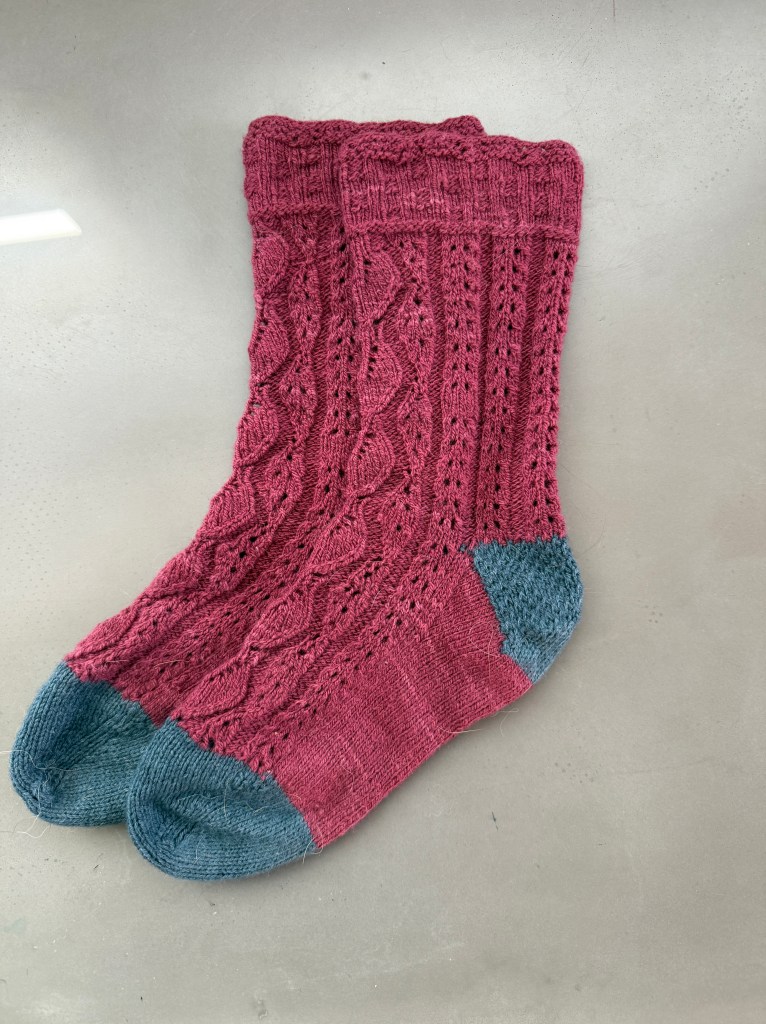
    These are not the socks I’ve actually been knitting these past few days; this is a pair that I finished before it was fire season. My daughter selected the colors and pattern from my stash.

    I’m grateful for all of the work that my past self put into making sure that I could weather these challenges. Many years ago, I learned to knit. And in the past few years, I’ve accumulated enough skeins of yarn, patterns, and skills that I can pick up a project pretty quickly. It gives me something for my brain and hands to do. Idle hands being what they are… And, of course, there’s always the satisfaction of finishing an item and then giving it to someone, sending it off into the world where it will do its thing. With each item I make, it’s a practice in letting go and in trusting that it will end up doing what it needs to do, being where it needs to be without any sort of effort from me. Once that final strand is woven in (ok, and I block it), it’s out of my hands. I’m done. It’s an exercise in letting go of control. Of course this translate into other areas of my life: parenting specifically. But also even with writing. I put the words on the page and hit publish or otherwise send it off. What happens beyond that is up to the universe. I have to be ok with that or else I’d never do any of it. But I am. And so I do.

  • How Will They Know I Love Them?

    This is the story of how I struggle with saying no to my kids. And also the story of how I struggle to say yes to my kids. And also of how I struggle to say yes to myself. And so therefore perhaps it’s about how I struggle to say no to myself. I guess maybe I could therefore say that it’s about how I struggle with decisions. And maybe that means that I struggle — and usually fail — to recognize the abundance that has been gifted to me.

    It begins with a corn dog. It was the weekend. My daughter wanted one. What she really wanted was to go to one of her favorite restaurants to get a corn dog and a bubble tea. But she never told me this directly, she just kind of hinted around it. I would like to say that I have a strong “mother’s intuition” and that I pay attention so closely to my kids needs and wants that they never have to express them: I just know. But that’s not what’s going on here. At first, I thought that my kids don’t always ask for what they want directly because they don’t like to hear “no.” But I’m starting to realize that my kids sense that I struggle to say “no” to them. They don’t like to see that struggle and so they edit themselves before it even gets to the whole asking directly for their wants and needs. They kind of “test the waters” with hints and indirect comments. It’s not to save themselves from hearing a no. It’s to save them from having to watch me flounder and go back and forth and try to make a decision.

    So I knew that she wanted to go get a corn dog. (Honestly, she’d probably want to get a corn dog every chance she got so this wasn’t any sort of revelation.) And I went back and forth inside my own head on whether or not I wanted to take her to get one. It would take a while, a chunk from their day off from school. But it’s always nice to have these types of trips with her or, really, any of my kids. Corn dogs aren’t the healthiest option, on the one hand. On the other, part of me really does believe in a sort of “do what you enjoy” attitude. We didn’t really have a set lunch at home so why not go out and get something? But, then again, I also had things I wanted to do and enjoy at home. And she had never really asked directly to go. I’d like to think that if there’s one lesson that I’m trying to instill in my kids, it’s to ask directly for what they want from me. And here I was trying to come up with an answer to a request that she hadn’t even made yet.

    And here’s the real crux of the struggle, “If I don’t anticipate and meet their every hearts desire, how will they know that I love them?”

    So I was in this internal state of debate, letting all of these back and forths slowly eat up my morning. Finally, she asked me, directly, “Mom, do you like the corn dog restaurant?”

    It was the first direct question she’d asked all morning about lunch and it wasn’t at all the question I’d been planning for.

    “Well,” I explained to her. “I like corndogs, but they aren’t the healthiest option for me and I’m trying to focus on eating in a healthier way these days.”

    And that was it. She didn’t mention the corndog restaurant again the rest of the day to me. She asked me to help her with cutting celery and onion so she could make herself a tuna melt, which she seemed perfectly satisfied with. And we had a perfectly nice time at home. We’d played volleyball together in the morning. Later, she came to me and asked if I’d play with her again. I was in the middle of writing a poem so I told her, “no.” She tried to convince me a little more but I stuck to my commitment to my writing.

    Of course, it wasn’t easy to say “no” to her. She wanted to do something perfectly wholesome with me, her mother outside on a lovely day. And, of course, in the back of my head, there’s always the thought, “one day my kids will move out and be on their own and I won’t have a chance to play volleyball on a beautiful fall day with them.”

    Later, I found out that she took that time to clean her room.

    And I realized that my always giving more of my time, my attention, my energy every time they ask for it isn’t helping them. I realized how much they are really, truly watching everything I do and soaking it all up. When I say, “no” to them, often it forces them to figure out a way to say, “yes” to themselves, to improving their environment, to taking care of themselves and their health. I had been modeling self-love all along and didn’t even realize it. But she had seen it. And now she could practice it for herself.

    “If I don’t anticipate and fulfill their every want and need, how will they know I love them?” They will know I love them because they see how I love myself. They know I love them because I do.

  • The Fall and rise of yin. (And Happy Halloween.)

    Autumn brings the rise of yin energy, which I’m happily receiving (which, is, appropriate given that yin is in part about receiving). I live in a place where capitalism, patriarchy, etc… creates an imbalance of yang energy — the more fiery, get stuff done, always be on the go, make, produce or die kind of energy is always around. It’s a little too easy to tap into it. To the point that even when I’m even wondering: “is it possible to embrace yin energy TOO MUCH?” This is about sitting back and receiving, after all.

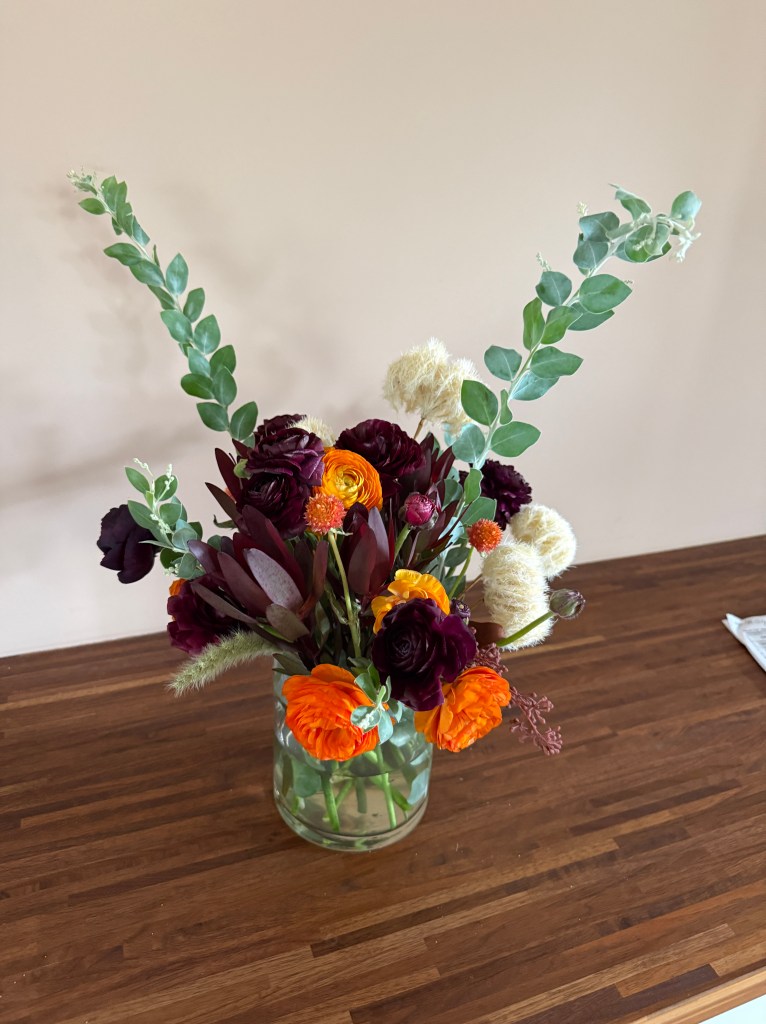
    The other day, I went to Trader Joe’s and picked up some flowers. At home, my daughter and I arranged them into a vase. It’s beautiful. I’m really proud of it. And every time I look at it, I think, “wow, that’s really beautiful” and I appreciate myself for having picked out and purchased the flowers and for having created a moment with my daughter from which emerged something beautiful.

    Isn’t it beautiful? Of course it is.

    I give it a 10/10 no notes. Would recommend. It was a completely perfect series of events and lovely outcome which I continue to enjoy.

    And one of the best parts of the whole thing was that I just received all of that. I didn’t doubt or question. I didn’t hedge. I didn’t think, “oh, I should have done this differently” or “this isn’t quite as good as that other bouquet, experiences, moments, thing that I saw on social media, etc…” I’ve experienced each step in the process of creating and I’ve enjoyed it and moved on to each next moment. Now, I look at this bouquet and think, “that’s really lovely, it really brings me joy and I’m so glad I did that.”

    It’s taken me work, a lot of work, to get to this point where I allow myself to just enjoy these experiences and connections and beauty. But the more I do it, the more I think, “I made something beautiful” or “I’m really proud of what I did” and the more I share these moments (for example here on my blog), the more they build and accumulate and snow ball. They drown out the hesitations and doubts.

    A thing that my daughter taught me recently. The reds and oranges and yellows and browns of autumnal leaves are always there. But from spring through summer, these colors are covered over by green. In the fall, the trees pull back their chlorophyll, which is no longer useful to them and what is revealed are those shockingly beautiful colors that have been there all along. I love a verdant summer. But I cannot sustain that: the constant going and growing and moving and producing. Even the trees can’t sustain it. And what is there underneath, once all that green has run its course and is pulled back, is just as beautiful AND has been there all along. Now is the chance I get to admire all that has been with me underneath the green all the time. I’ve always had it in me to choose a variety of flowers and arrange them into something striking. Now, in the yin energy of fall, is my time to appreciate that and all my other gifts. I hope you can too.

  • To Bike or Not to Bike?

    It’s a sunny, 60ish day here just outside of our Nation’s Capitol: a perfect day for a short, easy bike ride up to my local library. I’ve recently fallen in love with my library as a space to write and read surrounded by books and people who, for the most part, seem to also be readers and writers. Mostly, I’ve been driving up there but a few times recently, I’ve enjoyed the ride. So after checking the weather forecast for this week, I’d earmarked today as a day to ride. I loaded up my lunch, my notebooks, and books into my panniers and set off, helmeted and ready for the two miles or so.

    I live right next to a very busy highway that varies from 6 to 8 lanes. The library is on the other side of this road so I have to cross it at some point to get there. Lately, I’ve been using an unmarked crosswalk without a signal. Early enough in the day, there’s been a long enough break in the traffic that it’s a very lowrisk crossing.

    I’d pulled over to rest on a curb and to wait for an opening in the traffic when I saw the markings on the asphalt on the roadway in front of me. Blue and orange spray painted circles dotted the intersection. They might as well have been hieroglyphics. I did not understand them. But I did know why they were there.

    On Sunday evening, driving back from a family visit, there was an unusual amount of traffic along our residential streets. I conjectured that something was going on one of the arterial roads that was pushing traffic onto these side streets. Sure enough, after I pulled into our driveway, I went out to the highway to see the blue and red lights of emergency vehicles circling around. Eventually, two neighbors passing by informed me that a driver had hit a pedestrian and the roads were closed.

    So here I was staring at the orange and blue circles that meant something specific to someone about the events of Sunday evening. All they meant to me as I sat on my bike waiting for an opening in the traffic was that a person had been hit along this road. Again.

    The police would report that it was a 13 year old girl attempting to cross the highway who was in critical condition at an area hospital. This information was repeated by local news outlets. However, I heard from a reliable source that a teenage boy (a student at the nearby high school) had been hit by a car on Sunday evening along the same highway. So either the victim was misidentified or two people were hit by drivers along the same highway the same night. As unlikely as it might be, the latter isn’t entirely out of the realm of possibility. In the last four months, drivers have hit three other people in a slightly more than one square mile area. All three were killed.

    On the side of this highway, waiting for a break in the traffic, I wonder whether the drivers are thinking about the young person who was struck at this intersection like I am. I know that crossing this road is the most dangerous part of my ride to the library. I consider walking my bike up to a marked crosswalk with a signal, but both of those are a distance to walk especially pushing a bike on the narrow sidewalks. And then I have to consider my ride back home.

    So I climb off my bike and turn it around. As I’m riding back to my house, I consider whether or not I should just drive up to the library. Even if it is safer, I don’t really want to be another driver on the road. I’m lucky. I have a nice, safe house with most of what I need (other than, of course, the community of people at the library). I don’t have to go anywhere and even though I really could use the exercise and fresh air and human interaction, I have to weigh those benefits against the stress of trying to walk or bike safely within this infrastructure built for cars.

    Here I am, back at my house, having chosen the “not to bike” option. And I’d be lying if I said I wasn’t sad and disappointed. How I’d rather be at sitting at the library seeing those increasingly familiar faces, writing about something more joyful than drivers killing and maiming people, my neighbors. But this is what’s on my heart. And it’s honest. So at least there’s that.

  • Critical Response Process (aka “Gentle Workshop”)

    I learned this alternative process for a writing workshop from the poet, teacher, and writing mentor Ariana Brown. These are the five steps:

    1. The readers (viewers/ audience/ workshop mates) give statements of meaning.
    2. The writer (artist/ speaker/ performer, etc..) asks questions and can state their goals.
    3. The readers pose neutral (non-judgmental) questions and the artist can respond to those questions.
    4. The readers ask for consent to share opinion statements, ideas, suggestions. If the writer consents, the reader shares their thought.
    5. The writer can answer the question: “What are your next steps?”

    I’m going to delve a bit more deeply into how each of these five steps work and to give more information about my experiences with workshopping my writing both with a more “traditional” style of feedback and using Critical Response Process.

    I have an MFA in writing and a BS in English Education. I’ve experienced writing workshop since I was in elementary school and studied how to give feedback as a teacher and I’ve received feedback as a student in various workshops. For the most part the way that I’ve experienced feedback has been what I view as “traditional.” The workshop is comprised of a group of writers and one teacher/ leader/ expert writer. Each week (or however often they meet), writers turn in their writing so that the whole group has time to read ahead of meeting. In the meeting, each of the pieces that was shared ahead of time is “workshopped”.

    Up until this point, the Critical Response Process and the traditional workshop are the same. Here’s where they diverge.

    In the traditional workshop (as I have experienced it), each reader comments on the piece in turn. Other than clarifying questions, the writer is largely silent. In general, each reader shares their thoughts in a “compliment sandwich”: a positive comment, a suggestion, and then concluding with another positive comment. I’ve never had a workshop leader say that this is how it must be done, but it seems that everyone kind of just defaults to this way of commenting. Once everyone in the workshop has shared their thoughts, the workshop leader then usually wraps up the discussion with some sort of unifying overarching comments about the piece. At some point, the writer will have a one-on-one meeting about their writing with the teacher. (Of course, some writing workshops are peer-to-peer in which case there’s no private meeting and no one wraps up the discussion in a sort of “expert” way.)

    In retrospect, I can see how this format is not centered on the artist and their needs. The comments, at times, were rather arbitrary and based more on what the workshop mates wanted to talk about than what the artist needed.

    My experience with the Critical Response Process was very different. Here are some examples of how each step might be worded.

    1. Statements of meaning might include particular phrases or sentences, lines or images that resonated for the reader. It might also include what the reader took away from the piece of writing. Not everyone must comment during this part of the process. I found this to be a very nurturing and supportive place to start the whole process.
    2. The writer or artist might ask how the readers responded to specific images, language, moments, the form, etc… of the piece of work. They might ask for help sorting through parts they found particularly tricky or if the reader needed more explanation. I found this very helpful as a writer because it allowed me to ask for help where I needed it rather than just waiting to see if someone else brought it up. In addition, as a reader, it was helpful to learn where the writer specifically wanted help.
    3. Some examples of neutral questions, “How did you choose this topic?” “How did you decide what form to use?” “Where did you get your inspiration for this line?” I experienced this part of the whole process as driven by genuine curiosity. As a writer, it actually felt good that the readers were so curious about my process and my decisions. And as a reader, this often lead to rich discussions about process and a way to learn about other artists and how they work.
    4. At first, I was confused about asking for consent, but once I saw it modeled for me, it made sense. “I have an opinion about the title of this piece. Would you like to hear it?” Or “A piece of writing that reminds me of your poem. Can I recommend something that you might want to read?” Or “I have an idea about where you might submit this work. Would you like to know about that?” It was all very gentle and, for the most part, it just gave the writer more ideas and just furthered the discussion of their work and often contextualized it in a very empowering way. And once I saw it in action, I understood the consent piece. As a writer, I understood how maybe sometimes I just wasn’t in a place where I wanted to hear an opinion about something about my work and it was empowering to know that I could disregard what was said. Also, as a reader, it slowed down my response and reminded me that the person on the other side of the Critical Response is a human being.
    5. It was very nice to end the discussion back with the artist rather than the “expert” or “leader”. To me that was an empowering part of the experience and it served as a reminder that, actually, when it comes to my writing, I’m the expert.

    I found this process of giving and receiving feedback to be much more focused on the need’s of the artist, gentler, and more supportive than the more “traditional” workshops that I had experiences. I’ve also found that I can use a similar process to edit and revise and look at my own work. I don’t always need a whole group. And this has made me much gentler with my own writing.

  • Happy Summer Solstice

    It’s a few days late, but that’s what happens sometimes. And the thing about summer solstice is that while it might mark the apex of the sun’s power, it doesn’t switch off the next day. It’s a gradual, six month long shift. So the date, June 21, is, in many ways arbitrary. Like a lot of dates and deadlines.

    On Saturday (the date of the solstice) I sat down at my computer to write a blog post. I’d already been to the farmer’s market earlier in the day. And we’d decided to make some lefse to eat with sausages and hot dogs on the grill at our local pool. It seemed a perfect way to soak up these longest hours of sunlight of the year. Years ago, we were in Norway around the time of the summer solstice. It was striking how few hours of dark there were. We weren’t quite far enough north to experience the true midnight when the sun never sets, but it was certainly difficult to fall asleep and stay asleep. I realized how near-constant light made me crave the dark.

    Of course, last year, the solstice passed without me really realizing it. From what I can remember, I was at the beginning of chemotherapy treatment. The fact of the earth’s movement around the sun faded into the background. So this year, I’m grateful that I don’t need to be so hyper-focused on the granular details of getting through each treatment, each week, each day, each moment. The earth, tilted as it is on its axis, is moving around the sun. And that’s just fine by me.

    So it was that when I sat down to write a blog post on Saturday, that I already had much of the day planned out, just as I had much of my blog posting and month planned out. Somewhere in the back of my head, I was gunning for one hundred consecutive days of posting to my blog. The solstice was meant to be the 90th day of posting, which meant that I would cap off June with a celebratory post about posting to my blog for 100 days in a row. I’d already thought about how I’d write that 100th post about what I learned posting everyday: how I’d built up my confidence as a writer, how I’d learned to write through all of the internalized voices that I’d allowed to silence me. I was so close to that one hundredth day of posting. I’d already put in 89 days of work.

    And yet. When I sat down to write on Saturday, I went to open the correct tabs as had become habit, and a small voice asked, “what are you doing?”

    I just wasn’t feeling it.

    What I was feeling is that it was the weekend, my kids and husband were home, we had plans to make lefse and go to the pool to enjoy the extra minutes of sunlight.

    I had nothing to prove to anyway, least of all myself.

    Besides, I’d already done 89 days of blogging in a row. It wasn’t as if all the lessons I’d learned and momentum I’d built would just disappear because I didn’t blog on the 90th day.

    So I shut off the computer and went to spend summer solstice with my family. And it was glorious and lovely. I ended up going for two swims that day. I ate well. And enjoyed time with my kids and husband. I slept better than I had possibly in years without the aid of pharmaceuticals.

    There’s inherent tension between having goals and being in the moment. And I’m working through some of that. I fear that if I don’t set goals, then I’ll never get anything done. And I grew up in a culture where self worth is toxically intertwined with productivity. 100 looks nice on the page. And maybe it would garner more attention than 89. But it’s also arbitrary. And I’m not doing this to for attention. And now I just realized that I’m also not doing this (writing this blog, posting daily or regularly) to prove anything to anyone. I’ve already proven everything that I need to the only person I need to answer to: myself.

    And what have I proven? That I’ll always be here to take care of myself, to spend time doing things that make me feel good: to make lefse, to eat good food, to night swim with my kids, to soak up all the hours of sunlight that I can.

    As with many goals that I’ve set for myself over the years, the number one hundred is ultimately arbitrary. What isn’t arbitrary? That the earth circles the sun once a year, that once a year we get the most number of hours of sunlight in a day, and me.

    ************************

    *******************************

    ******************

    If you enjoyed what you’ve read here, please check out other posts. Likes, shares, and reposts help get my writing out to where it needs to be. I’m also grateful for financial support. Thank you!

  • A Daily Journal Writing Practice

    It’s been about five years now that I’ve been keeping a handwritten journal. In the last few years I’ve become consistent with it. And in the last two years I’ve become downright religious about it, building up a habit where writing each morning has become automatic. I look forward to it.

    Recently, I’ve been writing the date in Thai and Norwegian because those are two languages I’m working on learning and/ or improving. So it’s become an opportunity to learn and improve in those arenas. The hope is that after a year of doing this everyday, at least the days of the week and the months of the year are locked into my memory. I find something intensely satisfying about breaking large, seemingly impossible endeavors (such as learning a language) into smaller and smaller, very possible tasks.

    I write by hand. I also find this intensely satisfying. It slows me down but at the same time, I rarely if ever cross things out. What comes out on the page, comes out on the page. It’s unlike typing in the way. In this paragraph alone, I’ve probably hit the delete key at least two dozen times to fix errors or change words. But there’s a certain amount of acceptance that comes with writing by hand. I often just write an ellipses or even “I don’t know” or “ugh.” And that stands. I don’t really look back at the previous entries even though it would be east enough to do so. Perhaps some day I will. And I hope that what I see is how far I’ve come.

    For most of my life, I wasn’t comfortable with writing in a journal. I had a few experiences when I was younger when someone else read my journals. The reactions made me feel like it wasn’t a good idea for me to write down my thoughts, ideas, feelings, and experiences. All those missed years of those writing make me sad. But they don’t detract from the writing in my journal that I do now. In fact, it probably makes me more grateful that I have this ritual now.

    I write about what’s on my mind and things that are bothering me. And in writing about them, they bother me less. My problems feel smaller, more manageable when I can put them into words on a page. Sometimes I even come to some sort of solution or even just a new way of looking at situations.

    I get to know myself through the pages of my journal. And what I’m finding is that I’m a very reliable person, for myself at least, which is the most important thing. I return to my journal pages every morning and sometimes through the day. And I always find a steadiness. Consistency. I’m always here for myself. And even when I don’t have an answer, I listen well and deeply to myself.

  • Summer break begins

    It feels like this is the first day of summer break even though the kids have been off for school for a couple of days and even though summer doesn’t officially begin until tomorrow. I think it’s because my husband is off of work today. And this time last year, I was dealing with a new cancer diagnosis. I was so consumed by all of the appointments and details, getting through each day, I was barely aware of the seasons changing. It was a hard time.

    This summer, I’ve been able to look a little bit further forward, planning outings, swimming, taking advantage of farmer’s markets and other simple things that I completely missed last year. I started to try to plan today with my kids, going out to a museum. I was surprised that it was the kids who put the kibosh on that plan. They wanted to laze around a bit, read and maybe go up to swim at the neighborhood pool, enjoy what their own house and backyard have to offer. I realize now that part of me was feeling so guilty about all that I couldn’t do with them last summer and I was kicking off this summer by trying to compensate. As always, I over shot. Thankfully, my kids pulled me back.

    In myriad subtle ways and just in their being, they remind me that we can all be content with what’s right in front of us. We have already been given so much, there’s no need to keep striving for more beyond that.

    So instead of hoping on the metro somewhere else, my son and I made oatmeal raisin cookies. When he was first in kindergarten, I used to make them about once a week. He loved these cookies. It was such a simple pleasure and he acted as if he was starving in the desert and these were actual mana. Today is the first time he’s actually made them with me. I’m shocked by how capable he is, and how much he seems to enjoy my company. And I didn’t need to go even outside of my front door for these experiences and lessons.

  • Still learning.

    Is it a boundary setting hangover? Is it a vulnerability hangover? Is it a lack of boundaries? For all of my talk (writing) about how I’m trying to focus on myself, I still do it. I give too much of myself. I let other people make decisions about how I’m using my time and my energy. I keep putting oxygen masks on everyone else because, “What will they think of me if I’m sitting here putting my oxygen mask on when there are other people who don’t have oxygen masks on?”

    I keep forgetting the rules: What other people think of me is none of my business. And also: Do unto others what I would have done unto me. I am perfectly capable of putting on my own oxygen mask. I’d rather do it for myself than have some random passenger who thinks I need help but doesn’t have his own oxygen mask situation sorted help me.

    Here’s the thing. I’m learning.

    The other day, I went for a swim. A few days later, I felt rather sore. I probably pushed myself too hard. And I can kind of remember the exact moments when I pushed myself too hard: when I wanted to get another lap or a few more strokes in when I should have actually just slowed it down a little. So the next time I went into the pool, I was a little bit better about listening to when I need to ease off a little. My body is good about telling me.

    Another day, I gave someone just a little more time than I actually had. It threw off my whole day. And it probably disrupted my sleep that night. Next time, I’ll back off a little bit more in that arena too. When I was younger, it always felt like I had endless amounts of time to give to other people. Like a cup of coffee or a beer could easily turn into two or three and then a whole afternoon or evening. When I write about it now, it sounds kind of romantic. Youthful. This kind of feeling that I had all this time.

    Maybe it’s the cliche of the mis-spent youth but that feeling of just having hours and hours, endless days? Too often I spent it on the wrong people. Not that these people who I was spending time on were bad (although some of them were) but that I wasn’t spending that time on the one person I should have been: myself.

    I’ve only learned very recently that I actually really enjoy my own company. I enjoy being by myself. Yes, of course I also enjoy being with some people, some of the time. But I enjoy being with myself all of the time.

    ******************

    *************************

    *****************

    If you enjoyed what you’ve read here, please check out other posts. Likes, shares, and reposts help get my writing out to where it needs to be. I’m also grateful for financial support. Even though I post daily, I only send out a once a week summary email to subscribers. Thank you!

  • Brain fog, bills, and breath.

    I would have liked to have gotten here, to blogging earlier today but I’ve been on the phone with insurance, e-mailing and leaving voicemails with cancer center billing departments. It seems that at least one place is trying to bill me a second time. I triple checked my credit card statements. Brain fog from chemotherapy is a very real thing, my doctor (whose office sent me a bill for a payment I already made) assures me. So triple checks it is. I pulled out my calendar to make sure the dates of the payments and appointments lined up, that I didn’t just mis-remember everything through the brain fog. Sure enough, they charged my credit card.

    I didn’t sleep well last night — another side effect of one of my medications, apparently — and so I really would rather have been taking a cat nap or even just reading. OK, let’s be honest, even if I’d slept well last night, I would not have wanted to have to spend my morning dealing with medical bills.

    And the other one, well, I guess it’s my fault for not reading the fine print before receiving radiation treatment. Or not asking questions like, “how much is this going to cost me?” ahead of time. I guess I have too much faith in insurance companies to do the right thing and for providers to be up front about how things are going to be billed.

    It’s exhausting. A good chunk of my time, I was on the phone just trying to get to a live person, inputting the same information over and over and then when I finally got a live person, it was someone from a pharmacy, not billing. TWICE. Plus, the line was all crackly and there was some sort of lag time in our conversation. As if we were all in 1979, trying to make an overseas phone call. And, yes, part of me did think that this was by design, that the insurance company makes all of this as unpleasant as possible, hoping that you’ll give up. And I guess eventually I did.

    This is hard. Really, really hard.

    And, yes, I can turn to my breathing and meditation and all the rest of it to get through these moments, but the bills are still there. I can’t breathe the bills away. If I’d known how expensive cancer was, I wouldn’t have asked for it. Oh, that’s right. I didn’t.

    Still, there’s something about not receiving bills until all of the treatment is done that feels kind of gross. It would have been easier to swallow had I been told that I was going to be billed this way ahead of time.

    And right now, I just kind of need to write through all of this, just get it out and into the world. I wish I could be using this time and energy to write something beautiful and creative, to escape into something else. But right now it’s more helpful to me to write something real. And to try to be grateful that I have some place to at least do that.

    *********************

    ************************************

    **********************

    If you enjoyed what you’ve read here, please check out other posts. Likes, shares, and reposts help get my writing out to where it needs to be. I’m also grateful for financial support. Even though I post daily, I only send out a once a week summary email to subscribers. Thank you!