Blog

  • On Being Weird

    “Be weird,” was one piece of advice that Ingrid Rojas Contreras offered during an author talk at The Sanctuary (a virtual writing community for women of color). Or so I thought. Looking back at my notes, she might have said, “be strange.” Strange and weird are odd bedfellows. I’m embracing both.

    On mornings when I take a walk, I sometimes stop next to a creek. At first, it was to sit on a nearby bench, but the water wasn’t actually visible so now I go down closer to the bank. I take a few breaths, not necessarily deep, just whatever my body happens to be needing at that moment. Most times, I bend my knees a little, raise my hands up with each inhalation, lower them with each exhalation. I thought this was a chi gong or tai chi movement, but I looked on-line and can’t find this exact exercise. But I’m trying to not let that bother me.

    I used to take yoga classes regularly. In one lesson, the instructor told us to bend into a standing forward fold and then she said (at least I’m pretty sure she said) to “play around”. She then suggested (at least I’m pretty sure she suggested) that we experiment with stance, foot placement, arm placement, head and hip movements. So I started doing what I thought were her instructions, moving my feet different distances apart, bending at and grasping elbows. Most of the yoga classes I’d been to at that point had been pretty precise about where to place body parts and so I was a little surprised. Still, I took it to heart and thought, “this is actually really nice to just kind of see how all of these different positions feel in my body.” It was somewhat freeing to not feel as though I had to do exactly what the instructor told me to do. I don’t remember exactly what position I was in when she came over and stood next to me and said that what I was doing wasn’t actually a yoga posture.

    Come again? I thought.

    Now you might understand why now, looking back, I sure/ not sure that the instructions were to play around and experiment. That’s one of the things gaslighting does to you: makes you unsure that you heard what you heard. A yoga studio is an unexpected place for gaslighting. In retrospect, a lot of unexpected things are always going on in the yoga studios I’ve gone to. Or maybe it’s exactly how these “systems” are supposed to work. I came out of yoga with a lot of unfortunate ideas about how to treat my body, a lot of thoughts around how I’m “supposed” to hold my body and move my body and use my body. It’s unfortunate how a practice that was developed in the east to be liberating has ended up so confining in the west.

    I haven’t gone back to yoga for a few years now, but I have appreciated the work of Susanna Barkataki to decolonize yoga.

    Standing on the edge of the creek, breathing and moving in ways that just feel “right” to me (not because an instructor is telling me) is me being strange. Or weird. This whole practice of mine takes all of about a minute. And for the first few seconds of that, all I can think about it, “what if someone sees me?” Eventually, maybe by the third or fourth breath, the trees and the water give me courage to shake that thought off. They do see me. And what I’m doing (breathing and moving) doesn’t bother them one bit.

    Being weird is something I have to be intentional about.

    I just listened to an episode of Lori L Tharps’s podcast My American Melting Pot called “Talking to Our Kids About Race”. There’s loads of information in that episode, but one part of it relates back to this idea of being strange. Or weird. Or odd. One of the guests talking about how you have to be intentional about education yourself about race and exposing yourself (and your children) to racially diverse experiences. She used the example of how the algorithm on Netflix works. If you’re always watching British period dramas, Netflix is going to think that’s all you watch and will only recommend more British period dramas to you. And they will be mostly white.

    I few years ago before I quit Twitter, some of the targeted ads I was seeing were for Black hair salons. I’m not Black but I was evidently engaging in such a way that the algorithm seemed to think I might be. In no way shape or form was having Black hair salons on my feed damaging to me. In fact, alongside these advertisements, I was also exposed to increasingly varied and diverse content, much of which spoke to me even though I’m (with apologies) not Black.

    Black Liturgies by Cole Arthur Riley is one piece of content that found me because I was intentionally not watching British period pieces on Netflix (so to speak). In other words, I was making choices against the grain. I was being strange. Still am.
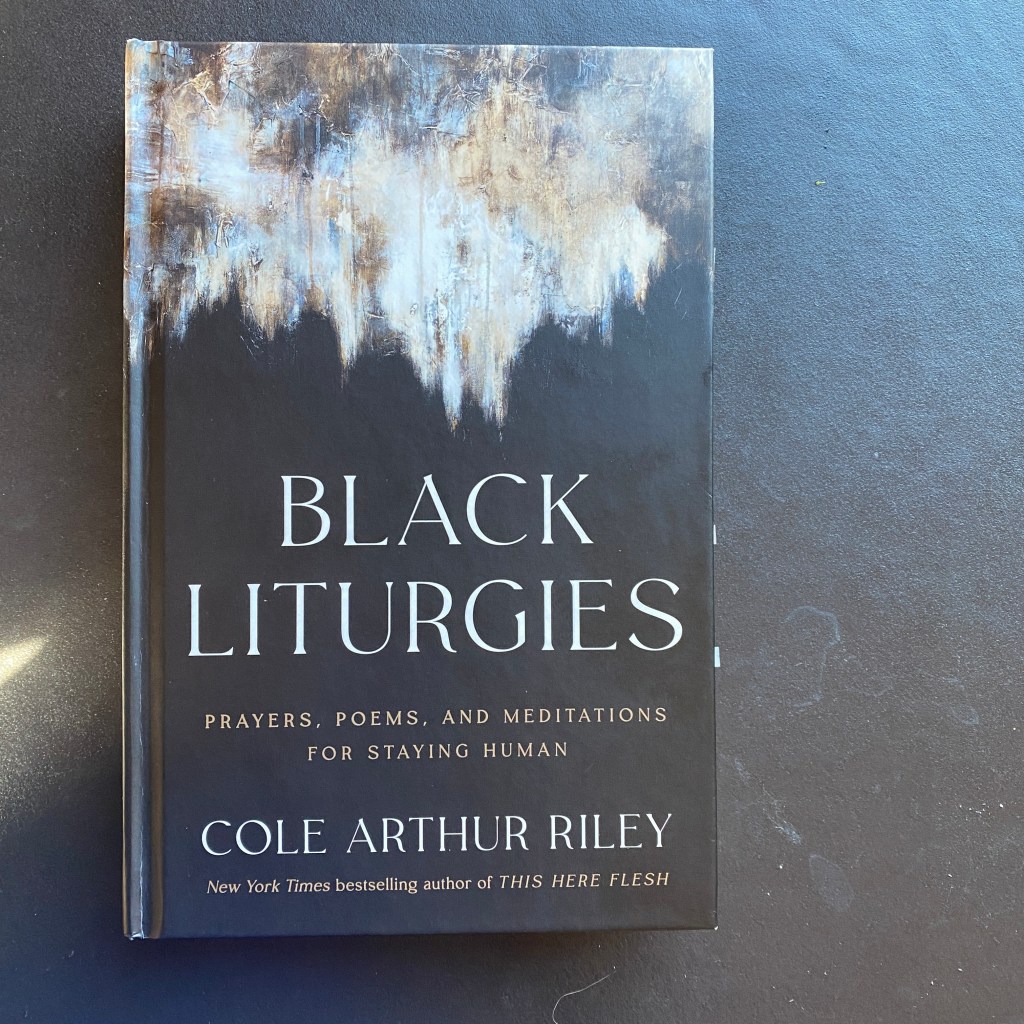
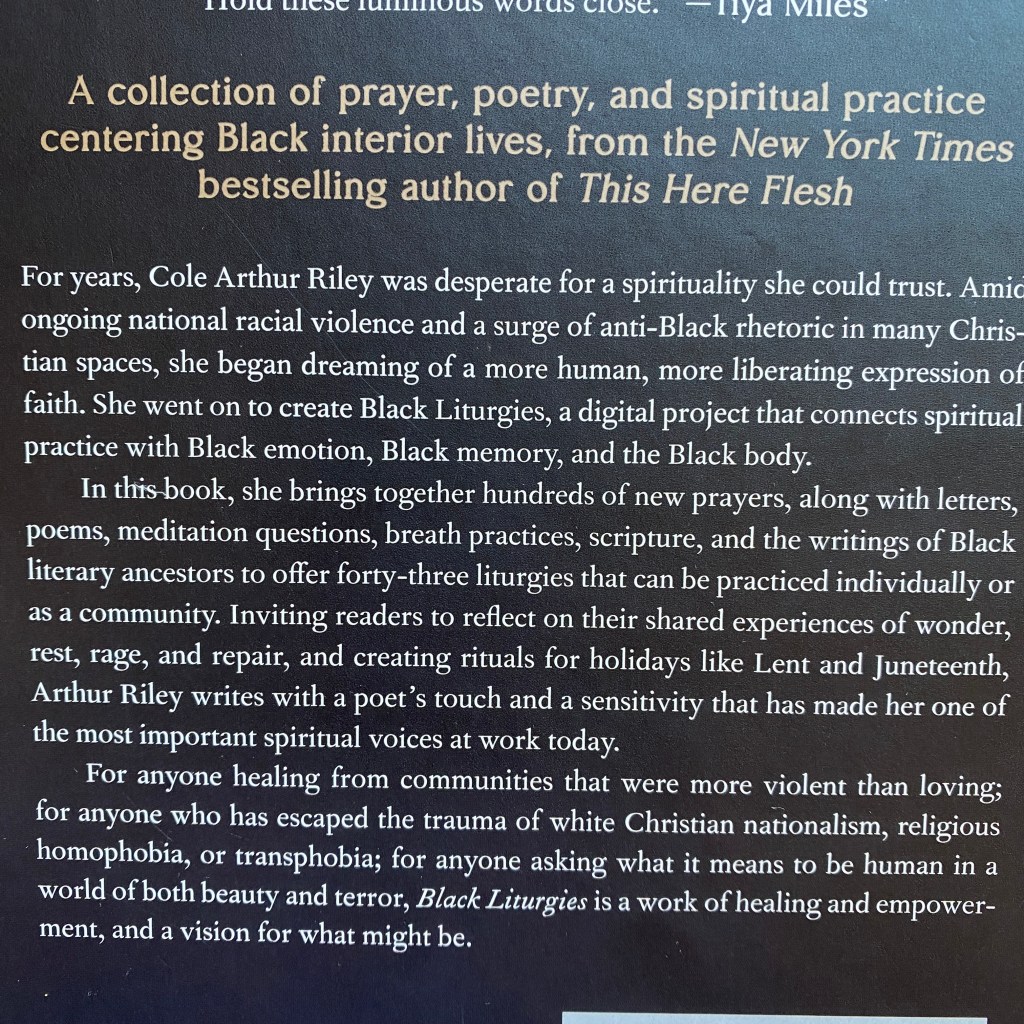
    For years, Cole Arthur Riley was desperate for a spirituality she could trust. Amidst ongoing national racial violence and a surge of anti-Black rhetoric in many Christian spaces, she began dreaming of a more human, more liberating expression of faith. She went on to create Black Liturgies, a digital project that connects spiritual practice with Black emotion, Black memory, and the Black body.
    In this book, she brings together hundreds of new prayers, along with letters, poems, meditation questions, breath practices, scripture, and the writings of Black literary ancestors to offer forty-three liturgies that can be practiced individually or as a community. Inviting readers to reflect on their shared experiences of wonder, rest, rage, and repair and creating rituals for holidays like Lent and Juneteenth, Arthur Riley writes with a poet’s touch and a sensitivity that has made her one of the most important spiritual voices at work today.
    For anyone healing from communities that were more violent than loving; for anyone who has escaped the trauma of white Christian nationalism, religious homophobia, or transphobia; for anyone asking what it means to be human in a world of both beauty and terror, Black Liturgies is a work of healing and empowerment, and a vision for what might be.

    The vast majority of the texts that I read as part of my colonized education were white texts, but in yet another instance of colonizer deception, they weren’t labeled as such. Black Liturgies already steps out from this line of conformity by calling itself what it is. Strange indeed. I would have been saved a lot of time and heartache if all those white texts I encountered in school had been as upfront.

    FOR THE UNKNOWN

    God of shadows,

    Our fear of the unknown keeps us from moving at all. Help us not to know. Protect our minds when anxious thoughts about the future refuse to leave us alone. Deepen our breath. Bring us into communities who can be trusted when they tell us we are safe. Comfort us when our minds become frenzied trying to determine what we cannot possibly know. When questions of what is to come or who will stay with us haunt us, make us kind with our own self talk, tender to our bodies, loving with all we do have control over. When no amount of courage can diminish fear’s power over us, remind us that we too have power as we rise to meet it. Provide a way to peace. We will not fear the dark. Ase.

    (From Black Liturgies by Cole Arthur Riley.)

    Again, I’m not Black but I’m reading a book called Black Liturgies. (Not just reading but returning to again and again for comfort and wisdom and strength and reminders of my own humanity.) Strange indeed. And yet this text spoke more to me than all the combined white texts that I was given in school. Stranger still. And I’m finding it to be pretty nice in this sea of strange.
  • Ivory Towers and Two of Wands

    Let me tell you something. When you’ve grown up in an ivory tower, deciding to jump, or step, or repel, or however you decide to descend is scary as fuck. It’s not the actual getting oneself to the ground that’s terrifying, it’s the decision to do so. I jumped out of that tower some time ago, leapt clear into the sky and plummeted towards the ground, braced myself for a rough impact that never came. Mother Earth is soft when she needs to be, especially her rich, loamy soil of the ground around the tower, exactly the distance from the base that I was able to leap. I’ve stood up, dusted myself off, checked for injury (there was none), and now I’m having a look around here. Damn it’s nice out here, down here! I should have done it sooner.

    Here, let me tell you about books and stories in the tower. It’s not that they’re bad … it’s just that there are so few of them. There’s not a lot of space up there at the tippy top of the tower so there are only like a dozen or so books or stories that circulate around there. In fact, one of the books is about how there are only seven stories in the world. They tell themselves this so they feel less bad about how few stories they have. And then they argue over which are the seven stories that should be allowed into the tower. They have systems for allowing some stories in and keeping some stories out. If enough people read one particular book, for example, they might throw another book out the window to make room for the more popular one. Sometimes a group of tower dwellers will get together and create an award and give it to that book and then that book is allowed to stay in the tower. Sometimes all it takes is one of more powerful tower dwellers to choose a book and then it gets to stay. Other times, someone will pay for a ginormous book and it will block out all the other stories. They’ve said that they are trying, they are really, really trying to get more books and stories in there, but, as they’ve explained, they really just don’t have all that much space. They say this and click their teeth, suck in air, and say, “sorrrrrry” and then make a really apologetic face.

    Looking back, I’m really struggling to remember why it was so difficult to choose to leave.

    Down here. Well, just look around. There are stories everywhere. Some in the form of books, yes, but also just, well, floating through the air and growing up through the earth, and in the flames of the fires, and on kitchen stovetops, and underneath beds and, well, you get the point.

    Where do I even begin? Sometimes, a book has been handed to me by a friend. Yes, there are still awards here, so sometimes I’ve found it on a list or in a review or on social media or from a podcast. And sometimes, honestly, it’s the book that’s found me.

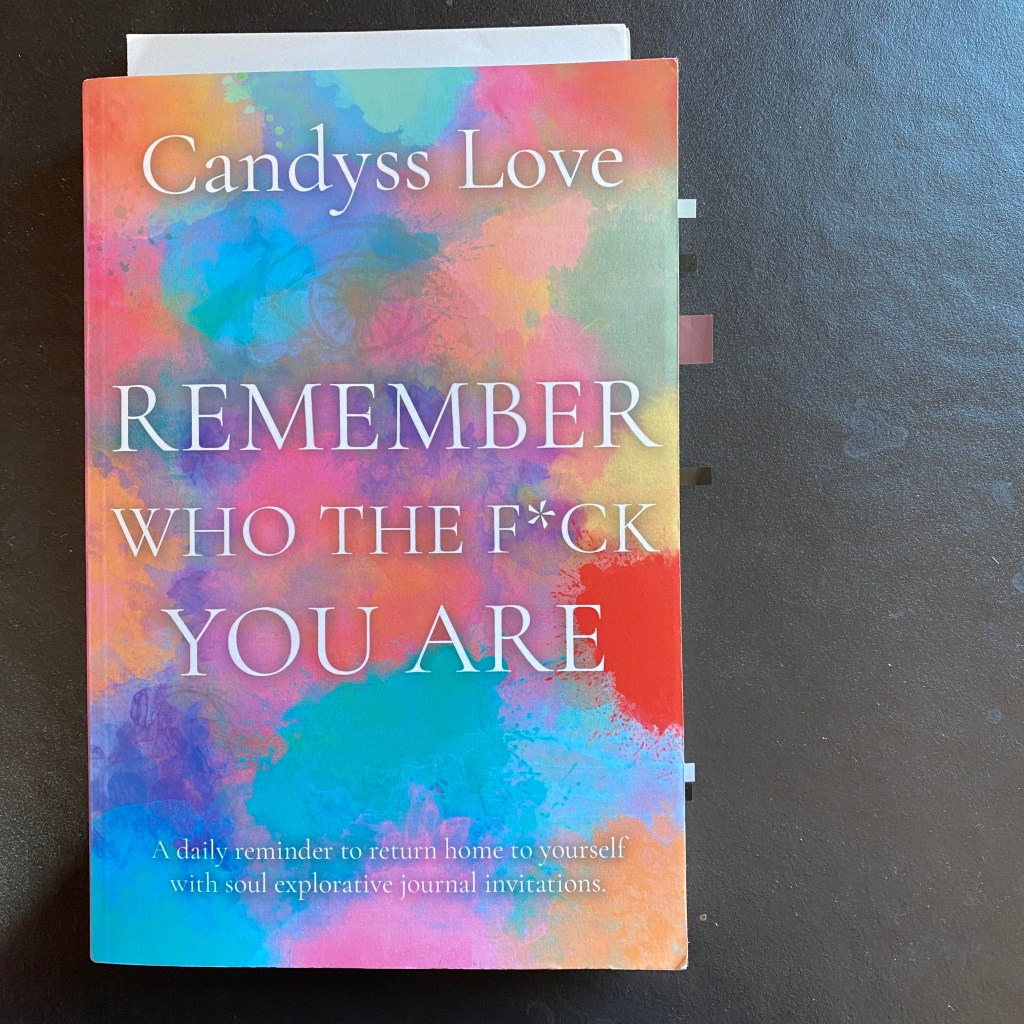
    Such was the case with Remember Who the F*ck You Are by Candyss Love.

    This is a self published book and self-published books are not allowed in the tower (or at least not in the towers I’ve been in) so, honestly, it’s one of the first ones I’ve read. I want to throw adjectives like sunning and authentic and heart-felt but none of those quite do justice. This book is comprised of page or two long …. meditations? essays? letters? Yes. Yes. And yes. And then some. Candyss Love recommends reading one section (titles include, “How many versions of yourself have you exiled?” “Don’t Manifest it, Heal for it”, “KARMA is not your personal assassin”, “forgiveness doesn’t mean re-entry”.) each day. And I did that, for the most part, although, admittedly there were days that I didn’t read, which even that feels providential because each of the sections seemed to come to me right when I needed them. It was like sitting down with a friend each day and having a real, deep conversation. That’s part of why it feels as if this book found me. If you’re reading this now, consider that perhaps it’s now finding you.

    A few quotes from the Remember Who the F*ck You Are:

    When we tell our stories we get to see how much alike we all are, how connected we all are and how much we share so many of the exact same experiences. When we hear other people’s stories our spirits start to connect on a deeper level and this opens the heart to learn more compassion, patience, and understanding. When we tell our stories, it gives others the confidence to come out of their shadows, to embody the power attached to their story and to stand firm in who they are and their experiences. When you own your story, you take your power back. (Page 104.)

    Anytime I write anything, it feels like a sixth sense, like a nudge or a voice. I never plan what I’m going to write, I don’t make outlines or rough drafts like we were taught in school. I just write from my soul and when I feel it or I’m given a topic from my spirit I stop everything I’m doing to write that thought out and follow wherever it leads me. (Page 247.)

    When you’re healing, what you feel doesn’t always have to be identified. (Page 292.)

    When you allow yourself to take up space you begin to see how beautifully your world expands and you become a conduit and teacher to others that secretly wish they could do the same. Take up space, love, exude the greatness that you are. Those that mind don’t matter and those that matter don’t mind. Period.

    In other words. Get out of the tower. I promise the landing is soft.

  • Bad Indians and Good Medicine

    Twenty or so years ago, I was working on earning my MFA in creative writing with a concentration in nonfiction. I’m not sure how it works these days, but back then we had to choose our genre of focus from among the big three (fiction, nonfiction, poetry) when applying to the program. The three years prior, I had lived in Thailand (where my dad is from) and one of those years had been in a refugee camp on the Thai-Burma border. Needless to say, the topic of my thesis was based around my experiences teaching (primarily English with forays into science) and living in the refugee camp. Was it a memoir? Was it reportage? Was it something else altogether? I still don’t really know, much to the chagrin (at the time) of some professors.

    I didn’t feel like I had a lot of support for my work other than from a few generous and caring classmates. I was naive and what I took as constructive criticism was actually silencing me and cutting me off from creativity. I was encouraged to write into a very narrow ideal. The path to that ideal shaved off most of what made me unique and human. At the time, I wasn’t aware that this was what was going on. In various ways, my professors called my writing disorganized, messy, disjointed, floundering and more. I internalized that.

    Since I graduated, I’ve had moments and stretches of writing and even publishing, but it was always a struggle for me. That narrow idea of what constitutes good writing struck with me and yet I was unable to shoehorn myself into that particular glass slipper. Rather than cut off my heels and toes to fit, I’d stop writing altogether for long stretches. (Although isn’t that a sort of self amputation?)

    In the past five years or so, I found my way back to writing just for myself in my journal. I would, on occasion even find my way to some sort of “finished” project to submit somewhere. And I had stretches of blogging (not this one, clearly, but one that I’ve since closed down). But it was always a struggle. I’d attempt to organize the messy, disjointed thoughts in my mind into something that would be acceptable or at least accepted. I caught dozens of arrow-like rejections. Internalized those too.

    A year or so ago, I swore off blogging even and let go of my last one. I kept writing for myself in my journal. But as for writing beyond that, well, let’s just say the rejection was coming from inside the house. So much had I internalized the comments about my writing, that I did everyone a favor and just shut it down myself.

    Over the past year or so, I encountered a few people, books, and communities that have started to rewrite that internal monologue for me. It’s been a slow process for me; the internalizations are bone deep. And so it was that limping and soul weary, I was called to the doorsteps of a few writing mentors. First, I joined a virtual writing community for women writers of color called The Sanctuary and created by Lori L Tharps. I took a poetry writing virtual class with Ariana Brown (and went on to do a mentorship with her). Both women are writers, champions of writers, and soul healers amongst many, many other things. And both have created spaces where I’ve been able to undo much of the damage done by my MFA. I am eternally grateful to them and I highly recommend any and all writers look to the resources they’ve created. Both Lori and Ariana eschew the concept of the lone, solitary writer furiously typing away in her room of her own. (Check out this podcast for Lori’s succinct take down of Woolf’s ideology). Rather, both of them preach the gospel of community. I was at first averse to this, so ingrained were the “go it alone” ideals of the MFA classroom. Falsehoods, all, of course. No writers that we studied were ever really doing it all by themselves and the most self aware never professed to. Ariana and Lori back up their words by offering workshops, virtual spaces, classes, mentorships and more which support writerly community. Of course, the most obvious place to find writing community is in books.

    And so I have also been reading and this too has been healing. I just finished Bad Indians: A Tribal Memoir by Deborah A Miranda and I am undone. Or maybe not so much that I am undone as the false lessons that I internalized in school are undone.

    Bad Indians — part tribal history, part lyrical memoir — plumbs Native ancestry, survivable, and the cultural memory of Indigenous California with intimacy, candor, and dauntless emotional honesty. In this now-classic book, Deborah A. Miranda braids together stories of her Ohlone/ Castanoan-Esselen family and the experiences of California Indians more widely, weaving the strands of oral histories, newspaper clippings, anthropological recordings, personal reflections, and poems into a one-of-a-kind archive, both playful and mournful, at once wise and defiant. Widely adopted in classrooms and book clubs throughout the United States, Bad Indians is an essential entry point for understanding the California Indian past and present.

    Above, I mentioned that my MFA program split up writers into three genres: poetry, fiction, and nonfiction. This division becomes comically arbitrary in the hands of a writer like Miranda whose book (which is marketed under “memoir”) forays into prose and poetry alike alongside graphics, fiction, primary source historical documents, letters, and more. Even Miranda’s own sleeping dream becomes source material. The end result is a three dimensional mosaic pulling pieces from unexpected times and spaces.

    I wondered, as I read, whether anyone ever told Miranda that her work was disorganized and disjointed. I’m guessing yes. And so it is that seeing and experiencing something like this in print is particularly healing to me as a writer who has felt constrained by this sort of commentary.

    The other thing that Bad Indians does so masterfully is to tell the story of the individual and the collective simultaneously. This, too, goes against so much of what we are told about what memoir is. My thesis for my MFA was about my time teaching and living in a refugee camp but it was also (attempting) to tell the stories of my students, co-workers, and those I was living amongst. But in order to complete my thesis, I felt I had to choose: either the story of the individual or the collective. It was not a choice I could make. Through these experiences, writing became a chore. It was neither liberating nor exciting to be always trying to hammer the stories I was telling into a western framework. By revealing what is possible when we move outside of this, Miranda’s work is re-invigorating for a writer like me.

  • Two Fortune Tellers and a Man Who Could Move Clouds

    The second time I attempted to have my palm read was in a village where I was teaching English in Thailand near the Burma border. The palm reader (I will call him Jim for convenience sake) was more than a palm reader but I will reduce him to that for the sake of this story. Anyway, it was my birthday and my gift to myself was knowledge of my fortune.

    Like everyone in the village, Jim lived in a bamboo and wood house with a grass thatched roof. He was a sort of mentor/ big brother type to one of my students, who was the one who brought me to Jim’s house and served as translator. Pleasantries aside, I showed Jim my palm.

    He pointed at a small freckle on the ring finger of my left hand. “This means you can kill a man by striking him.”

    It wasn’t the fortune I was expecting, but, still good to know my hands — or hand rather, just the left one — is a deadly weapon.

    “What will I be?” I asked him. Jim leaned back slightly and looked at me. I’d been referring to a career or even just a job. Will I be a judge? A teacher? A writer? I hope he sees “writer”!

    “You will be this,” he smiled slightly as he gestured his hand towards me, not quite as aggressive as pointing and not quite as subtle as a head nod. I wonder now whether Jim saw my disappointment in that moment. It would be years before I could begin to understand what a gift it was that Jim had given me. At the time I saw it as a non-answer. I was asking him to look into the future and see what exterior I will present. He was seeing into the present moment and seeing me as myself. And in this way, he was also seeing into the future. In some sense I was what I always had been and what I always would be. There is some essential “Rhena-ness” that has always been here and always will be here.

    But in that moment, I wasn’t able to understand that. Mostly, I was just disappointed that I couldn’t get an answer.

    At some point, I presented my palm to him and he peered into it.

    “Have you ever had your palm read before?” my student asked me on Jim’s behalf.

    “Yes,” I told them. A year or so prior, I had taken a short trip to India. In a hotel lobby, a man was offering to read palms and I’d taken him up on it, one of the bell hops kindly serving as translator.

    “Did the palm reader do this to you?” Jim asked me as slid one hand over his flattened palm.

    Had he done such a thing? I wondered to myself. It seemed that in the moment that Jim showed me the gesture, I recalled the man in India doing just such a thing to my hand. Or was this some small trick of memory? Had Jim doing the same created a new memory in my head? Neurons seemed to overlap and twist together in my brain and it’s funny how easily I go along with this potential remaking of my memories.

    “Maybe?” I said. “I don’t really remember.”

    “When he did this,” Jim explained, “he took your luck.” Or maybe the better translation would have been fortune or even karma. “And I can’t read your palm.” So this man in India stole my luck and put some sort of block on my palm to prevent future readers from reading? He’d censored my future? And how had Jim been able to tell this? Was my body, my aura, my spirit marked in some way? “Victim of karmic theft!”

    Since that time, I’ve sometimes wondered about those fortune tellers. In my mom cynical moments, I think, “Had Jim really been able to tell that I’d had my palm read before or was it just a good guess?” When I’ve had a run of difficulties, I’ve thought back to fortune teller #1. Had he taken my luck? Was this like some sort of curse? What did I need to do to undo it?

    And then I read The Man Who Could Move Clouds by Ingrid Rojas Contreras.

    For Ingrid Rojas Contreras, magic runs in the family. In Ocana, Colombia, her maternal grandfather, Nono, was a renowned curandero, a traditional healer who people said could talk to the dead, tell the future, treat the sick, and move the clouds. This was a vacation forbidden to the women in the family — until the day Mami suffered a fall that left her with amnesia, and on the other side of recovery, have her the ability to see and hear ghosts. In a long lineage of men, Mami became the family’s first curandera. Rojas Contreras grew up in a house teeming with her mother’s fortune telling clients and encounters with ghosts. The surreal was routine. This was a magical legacy she thought would never touch her life. But while living in the United States in her twenties, Rojas Contreras had a bike accident that left her with amnesia. Interweaving family stories more enchanting than those in any novel, resurrected Colombian history and histories of colonization, and her own deeply personal reckonings with the bounds of reality, Rojas Contreras writers her way through the incomprehensible and into her inheritance. The result is a luminous testament to the power of storytelling as a healing art and an invitation to embrace the extraordinary.

    Specifically, I read this passage:

    Nobody wants the truth, but everyone wants a story, Mami said.

    Tell yourself a different story, Mami now tells me.

    My whole life, Mami has been trying to teach me: there is no such thing as a curse.

    More and more, I understand what she means.

    Everyone suffers.

    To believe in a curse is to believe oneself above suffering.

    No one is above suffering.

    You can only believe in a curse if you believe in being spared.

    And there it is: the Four Noble Truths. And there, also, is this idea that I’ve been struggling with: that I can somehow “outwit” suffering. That my suffering was created when Fortune Teller #1 stole my luck (or maybe it was my karma he took) and the only way to resolve my suffering would be to either steal it back or re-build everything that he took. Who would have thought that living with my suffering would begin with accepting it? Well, honestly, Buddha would have (and did) think it as did Ingrid Rojas Contreras and her mother.

    I recently heard one of my writing mentors, Lori L Tharps, repeat one of her refrains: “memoir is magic.” I believe it. The Man Who Could Move Clouds re-affirmed that belief.

    ************************

    If you enjoyed what you’ve read here, please check out other posts. Likes, shares, and reposts help get my writing out to where it needs to be. I’m also grateful for financial support. Even though I post daily, I only send out a once a week summary email to subscribers. Thank you!

  • Read This: Hood Wellness by Tamela J. Gordon

    Until I read Hood Wellness: Tales of Communal Care from People Who Drowned on Dry Land, “wellness” was a concept simultaneously bland and poisonous. The price tag on all things wellness related created a world in which wellness itself — as in the state of being “well” — was unobtainable for most of us. And while certainly access to health care is tied up in race, class, and gender, the gatekeeping of wellness is a pure fiction, cooked up by an industry bent on distracting us from the potential and power in our own self and community healing while they reach into our pockets. In Hood Wellness, Tamela Gordon (or Tami as she refers to herself in this book)topples these fictions around wellness. From the rubble, she builds up a new narrative around self and community care.

    I have to admit that, at first, I struggled with this book. Or I thought I was struggling with this book. What I was actually struggling was to break out of the ideas around “wellness” that the industry had planted in my head: white monoracial, largely healthy and able-bodied (mostly) women as the center and keepers of knowledge around what it means to be “well.” It didn’t take long for Tami to break me out of that mental prison. The book opens with her in bed in the middle of what ends up being an unsatisfying experience. (For her anyway. Scott seems to be getting his needs met and then some.) In this section titled Care and Body, Tami keeps the focus on her own body and then on the bodies of other marginalized writers who she’s invited to share their stories. These bodies are not white, not wealthy, and not healthy nor able bodied. And, yet, these voices guide us all to a sense of wellness that is clearly not predicated in being in a certain type of body and income bracket.

    In this section, Tami also leads us through her own Eat, Pray, Love experience. She manages to share the same life lessons (and more) in one chapter which takes place over the course of a single day in which she never strays further than her own neighborhood. Elizabeth Gilbert needed a year, three countries, and three hundred plus pages to get to the same place. In other words, Tamela Gordon read, lived, and rewrote Eat Pray Love so that I didn’t have to. That, alone, is worth the cost of the book and then some.

    The sections of history in Hood Wellness were powerful. Tami writes about often overlooked historical figures including those in the Movement for Civil Rights, Hollywood film (and the “mammy trope”), and the ACT UP (AIDS Coalition to Unleash Power) movement. The way in which she takes an individual story (such as her own experience of being made to play a mammy role in a high school play) and contextualizes it in history (she tells us about Hattie McDaniels and other actresses) is nothing short of alchemy. Pain into meaning. Whereas white wellness creates a narrative that it arose from the sea in a giant pristine clamshell, Hood Wellness claims history and context.

    Since I read The Salt Eaters earlier this year, I’ve been drawn again and again to one of Toni Cade Bambara’s often quoted lines from that text: “Are you sure, sweetheart, that you want to be well? … Just so’s you’re sure, sweetheart, and ready to be healed, cause wholeness is no trifling matter. A lot of weight when you’re well.”

    Just because I’m drawn to this text, however, doesn’t mean that I understand it. But I was reminded of and given a deeper understanding of what Bambara was getting at in the afterword of Hood Wellness, written by Dr. Tyffani Monford Dent.

    “There is this misconception that healing is pretty. That it is made up of orchestra strings, lit candles, and happy endings that happen before the credits roll. Healing is just the opposite. It is hard. It can make one feel as if their soul is being crushed and that we might as well just stay within our unhealthy existence, because at least that difficulty is known. As Tamela reminds us, healing is ugly work. It requires getting down into the depths of our experiences and our souls and seeing all that is there — and trying to make sense of some things that make no sense. Yet, healing is cleansing.”

    I’m grateful to Tami for already having done so much of the work for us, especially those of us who live in marginalized bodies, ignored, made invisible, and objectified in mainstream wellness. I’m grateful that in Hood Wellness, she made sense of so much that doesn’t make sense.

    When I finished Hood Wellness, I had no interest in going out an buying some shiny, new product or signing up for a program. What was I interested in doing: listening to and reading more stories from people whose stories haven’t been welcome in mainstream (white) wellness spaces. And to get to telling my own.