Author: Rhena

  • Book Rec: On Thriving by Brandi Sellers Jackson

    Over the past year, I’ve been on a lot of difference medications, more than I think I’ve ever been on at one time in my life. I’ve spend part of three of the last four mornings trying to deal with my latest prescription: getting it filled, getting it paid for (yes, I have private insurance but apparently they don’t cover everything), and getting the instructions for taking it. Turns out, one of the drugs requires an EKG before starting and follow up ones after you’ve been on it for a while so now I’m trying to figure out how to get a copy of my last EKG to the prescribing doctor.

    But Oh Lord! the only thing more painful than trying to untwist the knots that comprise our health care system is writing about it. So I won’t. Instead, I’ll write about the prescriptions that I’ve received from bibliotherapist Emely Rumble (aka Literapy). How grateful I am that her lists of suggested readings don’t require an EKG or hours on the phone trying to get them filled!

    I got to enjoy a lunchtime talk by Emely Rumble in The Sanctuary (just another reminder of all of the amazing benefits of being a member of this virtual community for women of color) last year and her excitement about books and connecting people to just the right reading was infectious (see what I did there?). Emely has her own book titled Bibliotherapy in the Bronx coming out in the spring. I was inspired by her comments about how she had to push for the title of her book. I’ve read that some publishers don’t like to have place names in titles because… well, I think it’s just because publishers are going to have their elitist ideas about a lot of things and assume readers and buyers are the same way. As someone who loves to read about what it’s like to grow up and live in specific neighborhoods and as someone who can relate to a feeling of pride about the place you come from, I’m drawn to her title. I’ll for sure be getting a copy in April. In the meantime, she has loads of resources on her website for people interested in bibliotherapy, including book prescriptions.

    I found my current read On Thriving by Brandi Sellerz-Jackson on one of Emely’s lists. The subtitle is “Harnessing Joy Through Life’s Great Labors.” My first thought when I see the word “labor” is that I want to stay far away from it. I mean, labor is work and, honestly, I’m not looking for more work. Sellers-Jackson’s four great labors are relationship, mental health, grief, and being othered. I realized that these are labors that I’m already going through by the very nature of being human. And who couldn’t use a little guidance on “harnessing joy” through all of that? Certainly not me. And Sellers-Jackson proves to be a gifted guide. Her stories are not only beautifully told, but deeply personal in a way that cracked open my own vulnerabilities as I was reading.

    A couple of quotes that struck me:

    “[Self intimacy] is knowing and deciphering our voice as our own apart from others and those around us, finding it at its youthful genesis and unearthing it even when it is buried deep within the silt.” (P.17.)

    “[We] will find ways to be the most intelligent person in the room, not because we necessarily want to be, but because if we are, we can protect ourselves from those who possess the potential to cause harm.” (23.)

    Phew! These were just two sentences of many dozens that made me pause for a moment to realize, “she just unlocked some truths that I’ve known but never been able to acknowledge or express for myself.”Bibliotherapy indeed!

  • The Next 100 Seconds (A prose poem)

    (after Susie Q. Smith)

    Do not brace yourself. In the bracing, there is hesitation, and in the hesitation, there is doubt. There is no room for doubt here. Begin counting as soon as you’ve turned the handle all the way to cold. You will still have one or two seconds of warm water but this isn’t cheating because it’s not; this is your shower. Turn your back to the stream of water. Cross your arms over your chest, if they aren’t already there. First will come the gooseflesh and then the hitch in your breath (or maybe it’s the other way around; the fine details of sequence have little meaning at this point). Your breath will come in sobs. Allow them: these forceful diaphragm kicks. Your lungs are the seat of your grief, which your breath might want to kick around, shake up, expel every so often.

    Remember to keep counting. Begin to move from side to side, allowing the water to cascade over each shoulder. You can think of this as a warm up if that doesn’t somehow seem like a cruel joke. Gradually increase your movements. Soon you will be rotating your whole body under the stream of water. 

    Keep counting. You’ve been here before. Allow the memories of every other time you’ve been a bad-ass rise. That time you birthed a ten and a half pound baby. That time you said, “no” without explanation. That time you did not fill the awkward silence. That time you asked for help after the other time you asked for help and no one offered. That time you birthed a nine and a half pound baby. That time you said, “I don’t like that.” The time you lied and, in lying, remained true to yourself. That time you didn’t feel like smiling and so didn’t. Those times you smiled anyway and extended yourself grace later. That time you showed up to what everyone else knew was a gunfight and you didn’t even have a knife and you stayed anyway. That time you walked away. 

    Keep counting. You’re almost at the end. You can almost hear your Nordic forbear’s proud backslaps. Perhaps they even nod towards their tropical counterparts, who also value cold water, if not the displays of affirmation. No matter. You are whole. 

    Or skip the cold water. Read a poem instead. Read this poem instead. Keep counting. Look back up the page. How far you’ve come. A whole handswidth. Keep counting. Reach 100. Write a poem. 

  • Another Moment

    What emerges from a moment of silence? from stillness? What words need to be written right now?

    These are the questions that I’m asking right now. I know that there is an inner voice, deep inside of me that has been silenced and covered over by chaos. I spent a good portion of the morning on the phone with the pharmacy, my insurance, a pharmaceutical company, trying to get my latest prescription filled without having to fork over $120 each month. I felt like the ball in the old pinball machines slamming between those pop bumpers. By the end of the morning, the “notes” section of my weekly planner was filled with numbers and vague notes, none of which had anything to do with healing. Three or so of those minutes were spent listening to various messages, menus, and selecting options before I realized that I’d mis-dialed (I’d replaced the 888 with 800 because I apparently never left the 80s behind). It wasn’t until after I responded “yes” to the voice asking “can you hear me?” that I realized that the whole thing had been a recording. I’d been primed to talk about medicine and the scammers on the other end were prepared with an offer of a free medical alert device. As I hung up, I inwardly cringed for their real targets: those perhaps slightly older than me who also misdialed.

    So, yes, this is all part of the chaos that I have to dig through to get to some sort of silence. The stillness.

    I’m trying to establish some new habits and routines. This morning was my first time doing some stretches on my kitchen floor. The sun wasn’t up yet and so the lights, dim as I’d kept them, were reflecting off the glass of the windows, so that the pendants hanging from the ceiling seemed to be overlapping with the tree branches outside. I think that this will make me grateful for the next time I look directly at that tree, unhindered by the reflections.

    And that’s a bit of what I mean about the chaos layering over the silence, the stillness. I’d like to be able to hear the trees. But there’s so much noise.

    I set a timer when I stretch. Ten minutes. There’s no preset sequence. I just try to listen to what my body wants and needs. Move where it needs to go. Ten minutes is incredibly long when my body is in charge.

    I decided at some point that this would be a blog entry where I would just sit down, set a timer, and write what’s on my mind. That’s what this is then. I’m trying to …

  • Knitting and Cancer

    “You can sit and knit while receiving your infusion.” The physician’s assistant who conducted my chemotherapy orientation (yes, just like for freshman newly arrived on campus but with fewer ice breakers) made the whole process seem almost pleasant. And I was, in fact, a knitter, the type of knitter abbreviates “works in progress” to WIPs and, at the time, had no less than three WIPs in various, extremely cute project bags and one yarn stash large enough to require a big bin. But it had been months, maybe even a whole year or so since I had knitted. I had let that particular hobby drift to the wayside. I didn’t really think that cancer treatment would be the time that I was going to pick it up again.

    I love knitting. There’s a certain satisfaction of language fluency in reading and successfully following a pattern. And there’s the return to a WIP again and again, the gradual progress.  I love, of course, to finish a piece and then to give it to someone knowing that I already squeezed maximum enjoyment in the making. Any further happiness on the part of the recipient is mere extravagance. There’s also a human connection: not just between me and the person I’m giving it to, but between me and the shepherds, the spinners, and the dyers too. Perhaps most of all there’s the connection to the pattern maker, who spent countless hours converting the image in their head into yarn and then paper words for me to read and then reverse the process. I don’t personally know any pattern makers. But I know pattern makers. Know what I mean?  What a remarkable thing: to be able to spend weeks inside someone else’s head without every having met them. In science fiction, there’s often some sort of machine (in Star Trek it’s a transporter) that dematerializes an object and then rematerializes them somewhere else. Sometimes knitting is like that. 

    A few weeks after my orientation, I was sitting in my oncologist’s office with my husband for a pre-treament check-in with my doctor and his trusty medical transcriber. My eyes were closed and I was rubbing my fingers across my forehead. All I could think was complete darkness. Just blank. It was probably only seconds but it felt like minutes of just… nothing. Somewhere at the back of my brain, I felt there was a word or maybe a question that I was trying to retrieve. I felt the doctor and my husband waiting. The medical transcribers fingers poised on his keyboard. Finally, the doctor’s voice cut through. 

    “Are you having trouble recalling words?” he asked. 

    “Ya’ think?!?!” I wanted to reply back, but while the snark was there, the language to convey it was gone. 

    “Yeah,” I said. “I think I had a question, but now I can’t think of it.”

    The doctor reassured me that this is normal and that words would come back. What could I do but believe him?

    As it had been explained to me, chemotherapy targets rapidly dividing cells. Ideally, this means that it wipes out cancerous cells. Realistically, hair follicles, the digestive tract, skin and immune cells can all be collateral damage. In my own way of thinking about it, while on chemotherapy, my brain also wasn’t able to form new neurons. This is how I explained the language loss to myself. Or maybe it was the stress of the whole situation. Or that my known information was being overwritten by new cancer patient vocabulary: HER negative, dexamethasone, neuropathy, taxane, and a dozen other that I realize now I never actually learned. Somewhere along the way, I decided to leave it to the doctors and nurses. My own language became much more rudimentary: sleep, pain, eat, poop. At times, I was an infant once again. I could feel people around me internally cheering when they could illicit a smile or laugh from me, just like they do with babies. 

    I never did bring any knitting projects with me to chemotherapy treatments. Knitting is a relaxing pastime but it is also an act of resistance. It is all the things that modern, western society and capitalism looks down upon: feminine, slow, collective, inherited knowledge, sustainable, creative and nourishing. In our culture, it takes time, energy, and focus to maintain those types of activities. So does cancer treatment. The second months of my chemo involved Benedryl, which would usually make me sleepy, and ice packs on my hands to help prevent nerve damage to my extremities. I couldn’t have knit even if I’d had the energy to open up my WIPs and figure out where I’d left off. Besides, in the midst of all of this, it was impossible to prioritize knitting. All those years of learning and doing and making, I shoved it all to the back corner of my brain. Would I ever return to it? It didn’t matter. 

    But no, there’s more to it than this. I just admitted that my language abilities are greatly diminished. And yet here I am, writing and asking you to trust me that this is all going somewhere in spite of my reduced capacities in the very medium in which we are currently communicating. Am I an unreliable narrator then? Are we all? Here. Let’s go back. I trusted the doctors to know the words necessary to eradicate the cancer. Now, I need to trust myself that I have the words to tell this story. It’s not an easy thing, trust. 

    Spoiler alert: I’m knitting again. This fall, I made a charming green hat for my charming nephew. (I’d drawn his name in our family gift giving.) It’s been a pleasant little surprise each time I’ve picked up my knitting these days. It’s so easy! I remember all of it, each of the little steps from balling the yarn to casting on, checking gauge to reading a pattern. And where I’ve forgotten, there’s someone on-line or a book with the necessary information. How did this happen that I can still do all of this? I was recently doing an Old Norwegian cast on and it felt so natural that I wondered whether my ancestors from there weren’t gently working through my bones. 

    The question that I had in the doctor’s office popped into my head one day. I’d wanted to ask if he thought I needed to start on the antibiotics he was prescribing right away or just have them on hand in case of infection. It turns out that he’d already explained that and my husband was there, paying attention where I could not; his brain forming neural connections while my own cells were otherwise occupied. 

    And here we are, at the end of this post, ready to bind off, having sustained each other’s attention against all the odds and distractions. And still here. 

  • The Gift of Books

    Two weeks ago, I had 57 unread books on my shelves. Here’s what I’ve learned since then: it cost me 60 bucks and two newspapers for my eleven year old wrap them each individually, number them, and create corresponding “tickets” on scraps of paper within a specified time frame.

    I saw this system of randomizing your reading many years ago on Instagram or some other social media. At the time, I probably scoffed at it. “What a waste of paper! Just pick a book and read it!” But the idea hung around somewhere in my brain until I was 57 books behind on a bad book buying habit with an 11 year old eager to earn some cash and with a passion for gift wrapping whilst watching “Only Murders in the Building” with her mom.

    Here’s how it works. All the unread books (or at least the ones that aren’t in boxes in the basement) are wrapped up in paper. She then labelled each with a number, which is then also put on a small piece of paper. I keep all the numbered papers in a small box. When I’m ready to start a new book, I pick a number and read the book. This saves me from fussing around when I’m trying to decide which book to read next. And I’m a notorious fusser. Besides, making decisions is exhausting and I’d much rather spend that decision making energy on something more meaningful, like which murder mystery series to watch with my daughter next.

    “But why do you wrap all of them in newspaper?” my husband asked. Maybe you too have the same totally reasonable question.

    Two reasons. One, if the books are just sitting out, unwrapped, make no bones about it, I’m going to get distracted by them. I’ll go to retrieve my randomly chosen book and “Ohhhhh… look at this one with the pretty cover and pages and words….” and before you know it, I’m three chapters in before I realize that this is NOT THE SYSTEM I DEVELOPED! And then I have to go back to the chosen book. A few weeks or months later when pretty cover book is randomly chosen, I will have already read a few chapters and it will be very confusing. The second reason the books are wrapped is so that they can be unwrapped. Who doesn’t like unwrapping a book? It’s like a little gift to myself each time I pick a new one.

    So far I’ve picked two books. The first ended up being The Fire Next Time by James Baldwin. It’s a stunning book. My most measures, I’ve had a varied education in terms of what was “assigned” reading in the different schools I’ve attended. I continue to be shocked and kinda pissed off when I keep finding books that weren’t assigned in school. I mean, I’ve taken at least a few literature classes across various levels and I honestly cannot remember being assigned any James Baldwin. It’s a travesty.

    The second book I picked was volume 124 of the literary magazine Bamboo Ridge. I’m currently about a quarter way through it and it’s lovely. I’m so glad that I ordered it (and another handful of Bamboo Ridge volumes) some months ago in the middle of the night when I couldn’t sleep. My present in-need-of-personal-and-local-stories-and-poems self thanks my past insomnia self. For many reasons (although mostly that indigenous Hawaiians have asked tourists not to) I will not be visiting Hawaii any time soon. But the writing in this journal is so much better than visiting a place where I would only ever get to experience it as an outsider, a tourist, someone extracting and not giving. I feel like I’m experiencing real Hawaii (and real life) as I’m reading it.

  • Let it be known (a poem)

                (after Brently Caballero)

    Never, not once ever did I ask, “Why didn’t you tell me?”

    But I always learned your name. Tried at least. 

    Tell my people that my favorite fruit was durian

    unapologetically

    leave it on my altar.

    Tell my people, yes, they will build an altar. 

    “You will dance an altar.

    You will sing an altar.

    Write it. Sculpt it. Grow it. Chisel it. 

    Dream an altar.  

    And to be clear, tell my people the altar will be for me.

    Tell them. Tell them that the picture they place on the altar.

    will highlight my rather nicely shaped head 

    which is a tribute to my nana

    who never set me down alone on my back.

    Tell them not to hide my freckles, the scar on my left cheek

    the one born of vanity 

    (ha! the irony) 

    and the one above my heart

    born of times of trouble we neither

    hide nor talk about. 

    Tell him “she wanted to compliment your glasses but she’d already commented on 

    your hat and how well that shade of orange suited you.” And maybe being less worried about what people thought might have freed her, did free her.  

    Tell them it is only fitting 

    to burn these bones born, 

    as they were, 

    in the year of the fire dragon.

    Tell my people that I was afraid of dying

                until I realized 

    until I saw the truth, stark and bare, 

    of all the people

                I could haunt

                first among them 

    the celebrity so-called chefs

    who hate durian.

    Tell them. Tell them. 

    Tell my people she wrote this poem knowing full well it could be her last

    Tell my people she loathed to be the one to tell you it could also be your last. 

    Tell my people

                her listen long time

                her create long time

                her destroy some time

                her forgive long time

                and her, of course, love you long time. 

  • My young self …

    …loved the yesterday that I made. I woke close to 7am and baked banana bread. The children had a late opening to school so this meant the bread was ready before they had to leave. My young self was proud that the timing had worked out. My old self felt I should have had it done even earlier so that there had been more time for it to cool before cutting it. Fortunately, my young self is louder than my old self and loves to watch the steam float from between the slices.

    My young self enjoyed the extra time with my kids in the morning. My old self lambasted the ice and cold even as my young self successfully stoked the fire. My morning involves a “create before you consume” ritual. Usually I write, but my young self counted building up the flames in the woodstove and baking banana bread as creating. My old self does not think I should think of these activities as “creating”. My young self thinks my old self can be a bit of a puritanical asshole. She’s not wrong.

    I had errands to run that took me near to a Michael’s craft store which my old self thinks is an uninspiring chain warehouse full of plastic and trendy crap. My young self’s heart leapt when I granted her permission to buy some beautiful sets of markers which we have the money to afford. Sometimes both of them are right.

    My young self marveled that I could make the choice to practice guitar for thirty minutes in the middle of the day just because I could and at the improvement I made even in that short a time. My old self reminded us, “loosen up!” when my shoulder ached from holding it in one awkward position for an unnecessarily long time.

    When I realized our family had overbooked, I did the grocery store trip, driving one child to and from various basketball practices, and started dinner (beef stew!) prep. My young self was very impressed by my adaptability, but it was my old self who had the sense to ask my husband to finish making the dinner when I knew I needed rest. It was all three of us who let out a long, hopeful sigh as we sat down next to the fire.

  • This Moment

    I spend a lot of time thinking about writing. I also spend a lot of time actually writing: it’s often one of the first things I do in the morning. I have pages and pages and notebooks and notebooks and digital docs full of words in the specific combinations that I’ve come up with. And, yet, relatively few of them have made it into this blog. What’s up with that?

    I’m writing on my iPad in my living room on the couch next to our woodstove which is lit (by which I mean there’s an actual wood fire in there; not like “this party is lit”). It’s somewhere around 17 degrees (farenheit) outside right now and our furnace went out a few weeks ago. Fortunately, we actually have two furnaces and we got the broken one fixed right away but in the process of getting it fixed, we discovered some larger electrical problems which have made us skittish about using the furnace. Our woodstove was expensive and, honestly, it’s kind of fantastic to be using it for more than aesthetic reasons. And by “fantastic” I think I mean all that expense feels very justified. Plus, fire is a beautiful thing to be able to stare into.

    I have various notebooks and journals, one of which is dedicated to this blog. I like to write longhand, in cursive. This probably has something to do with how I learned to write in school and my age and the history of technology and my specific brain development, but I won’t bore you with trying to piece together the timeline. I also used to be an English/ Language Arts Teacher so this step-by-step process of writing (brainstorm, outline, draft, revise, edit, etc…) is pretty deeply engrained me. But I’m not doing this blog post that way. I think the young people these days would say I’m “raw dogging” it which is a term which I’m assuming comes from something sexual and which my kids would cringe to see me using. So what I really mean to say is that I just sat down and started writing this post — no brainstorming or notes or even an idea much less drafts.

    Who the hell gave me permission to do that?

    Well, I did. This is my blog.

    This is revolutionary thinking for someone like me who has spent much of her life feeling like she has to get permission or approval for, well, pretty much everything and specifically for writing. And yet writing is one thing that I’ve been doing a lot of. I’ve been overly precious about writing though. It only counts if it’s in certain publications. It only counts if I’m getting paid. It only counts if I’ve gone through a certain number of drafts and covered the whole thing in blood, sweat, and tears (my own, of course). It only counts if it’s beautiful and perfect and inspired.

    Ugh. How insufferable is that inner monotonous voice counting every bean and bob, jot and tittle?

    Every word I put down here is shouting over that annoying inner voice. Every time I click the “publish” button, I’m punching those gatekeepers. Each time I write here, I’m reaching out.

    I’m here. Welcome.

  • Tomorrow, I Will Learn Whether I Will Become an Archer

    I have breast cancer. But that’s not really what this post is about. This post is about how the news I receive tomorrow will decide whether or not I will become an archer.

    The truth is, I don’t really want to take up archery. I already have a good number of interests and hobbies and things that take up my time and keep me occupied. The archery club is the next suburb over so while it’s not a long drive, it’s not where I’d like to spend my time. Still, I’ll do what must be done.

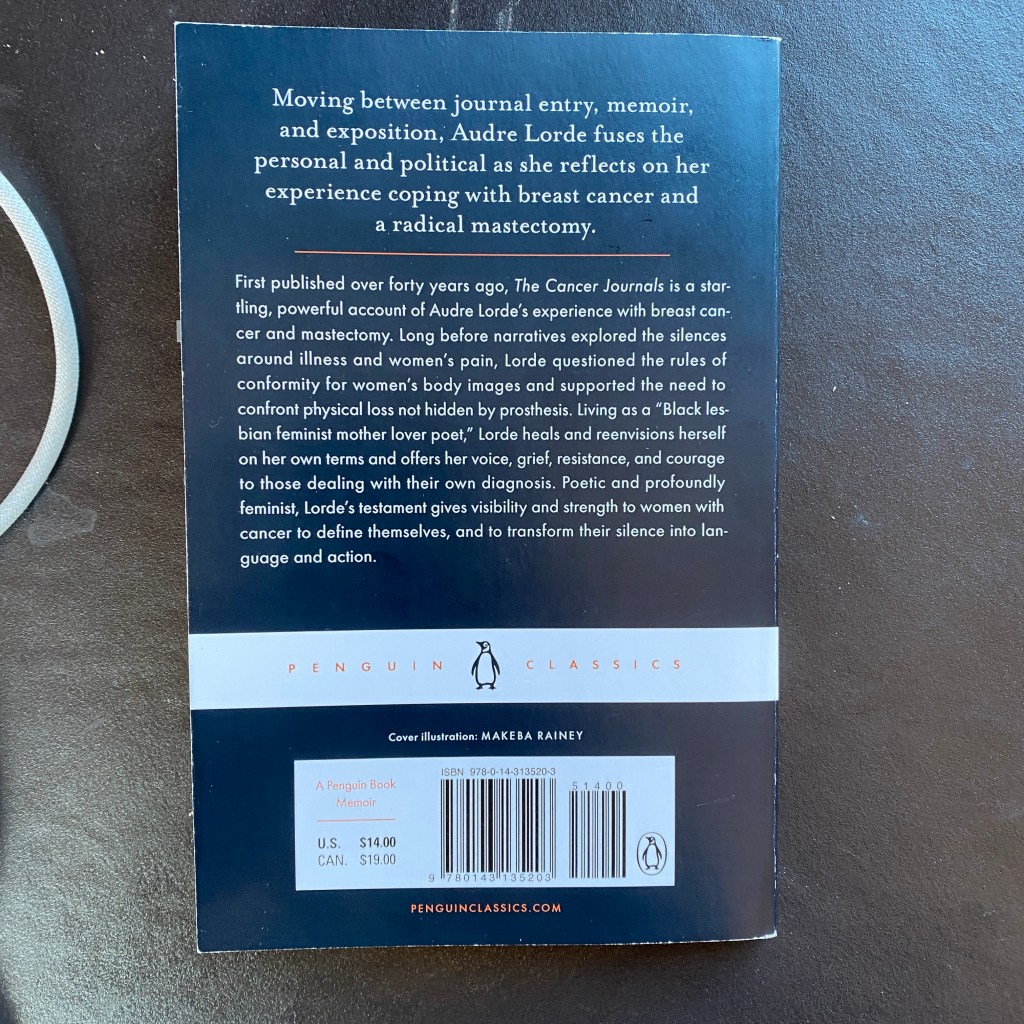
    Here’s how I came to find out that archery qualifies as “what must be done.” My cancer diagnosis led me to Audre Lorde’s book The Cancer Journals. Turns out, I love Audre Lorde’s writing but I definitely would not have picked up this particular piece had I not been feeling a little lonely and self-pitying in my diagnosis. In one entry in her journal, Lorde writes,

    And yet if I cried for a hundred years I couldn’t possibly express the sorrow I feel right now, the sadness and the loss. How did the Amazons of Dahomey feel? They were only little girls. But they did this willingly, for something they believe in. I suppose I am too but I can’t feel that now.

    The footnote to this section reads, “It is said that the Amazon warriors of Dahomey have their right breasts cut off to make themselves more effective archers.”

    Moving between journal entry, memoir, and exposition, Audre Lorde fuses the personal and political as she reflects on her experience coping with breast cancer and a radical mastectomy. First published over forty years ago, The Cancer Journals is a startling, powerful account of Audre Lorde’s experience with breast cancer and mastectomy. Long before narratives explored the silences around illness and women’s pain, Lorde questioned the rules of conformity for women’s body images and supported the need to confront physical loss not hidden by prosthesis. Living as a “Black lesbian feminist mother lover poet,” Lorde heals and reenvisions herself on her own terms and offer her voice, grief, resistance, and courage to those dealing with their own diagnosis. Poetic and profoundly feminist, Lorde’s testament gives visibility and strength to women with cancer to define themselves, and to transform their silence into language and action.

    I took this for the sign that it is. Surely, if I’m am to have to have my right breast (or both even) removed (which I will find out tomorrow), then I must take up archery. Even though this prospect feels like some combination of fate, destiny, and duty, when I’m in the right frame of mind, I can almost look forward to picking up a bow and arrow. It’s supposed to be very good for upper back strength. And I suppose I might develop a skill that might actually be useful in the end days when we will all need to hunt our own food. Or that’s what I tell myself.

    If I do need to have a full breast (or breasts) removal, will I actually take up archery? Will I be any good at it? I don’t know. I’m not a fortune teller. But telling myself this, giving myself something to look forward to has allowed me to face tomorrow and the news I’m facing.

    And reading Audre Lorde has done the same but in a backwards looking way. Not only was she going through breast cancer and a mastectomy nearly fifty years ago when medicine and attitudes both were less developed, she was experiencing it as a Black lesbian in America. Amongst other trials, Lorde was shamed in the doctors office for not wearing a prosthetic.

    And yet she did not despair. Not only did she not despair but in the midst of it all, she left a document, a road map of sorts for the women who would come after her facing the same grim diagnosis. I do not think it is, therefore, too much to ask of my future self to do her duty and pick up the bow and arrow.